
Jewelry terminology explained is the vocabulary system that defines gemstone weight, metal purity, setting styles, and craftsmanship standards used across the fine jewelry industry. Knowing the difference between a karat and a carat, or between vermeil and gold-plated, directly affects how much you pay and what you actually receive. Buyers who understand these terms spot misrepresented products, ask better questions, and make purchases they do not regret. This guide covers the core vocabulary you need, from FTC-regulated metal classifications to hallmark stamps and setting styles, so you can evaluate any piece with precision.
What is the difference between karat and carat in jewelry?
Karat and carat measure different attributes entirely, yet they are the most frequently confused pair in jewelry vocabulary. Karat measures gold purity on a scale of 24, where 24K equals pure gold. Carat measures gemstone weight, with one carat equal to 200 milligrams. Mixing them up leads to real misunderstandings about value and quality.
Here is how each term plays out in practice:
- Karat (K): 24K gold is 99.9% pure but too soft for most jewelry. 18K gold is 75% pure gold mixed with alloys for durability. 14K gold, the most common in American fine jewelry, is 58.5% pure gold and balances cost with wearability.
- Carat (ct): A 1-carat diamond weighs 200 mg. A 0.5-carat stone weighs 100 mg. Carat weight affects price significantly, but cut and clarity determine how impressive a stone actually looks.
- Why the distinction matters: A “14K, 1-carat diamond ring” contains 14-karat gold and a one-carat diamond. If you confuse the two terms, you cannot accurately assess what you are buying or whether the price is fair.
- Price impact: Higher karat gold costs more per gram. Higher carat gemstones cost exponentially more per carat, not linearly, because large stones are rarer.
The biggest common buying mistake is treating these as interchangeable, which leads to confusion about the true value and quality of a piece.
Pro Tip: Use “K for King metal, C for Crystal weight” as a memory anchor. Gold is the king metal, so karat belongs to gold. Crystals and stones are weighed in carats.
How do vermeil, gold-filled, and gold-plated differ?
These three terms describe gold-covered jewelry, but they are not equal in quality, durability, or legal definition. The FTC Jewelry Guides exist specifically to standardize how metals and plating categories are described, turning vague marketing language into verifiable claims. Knowing the exact definitions protects you from paying vermeil prices for gold-plated quality.
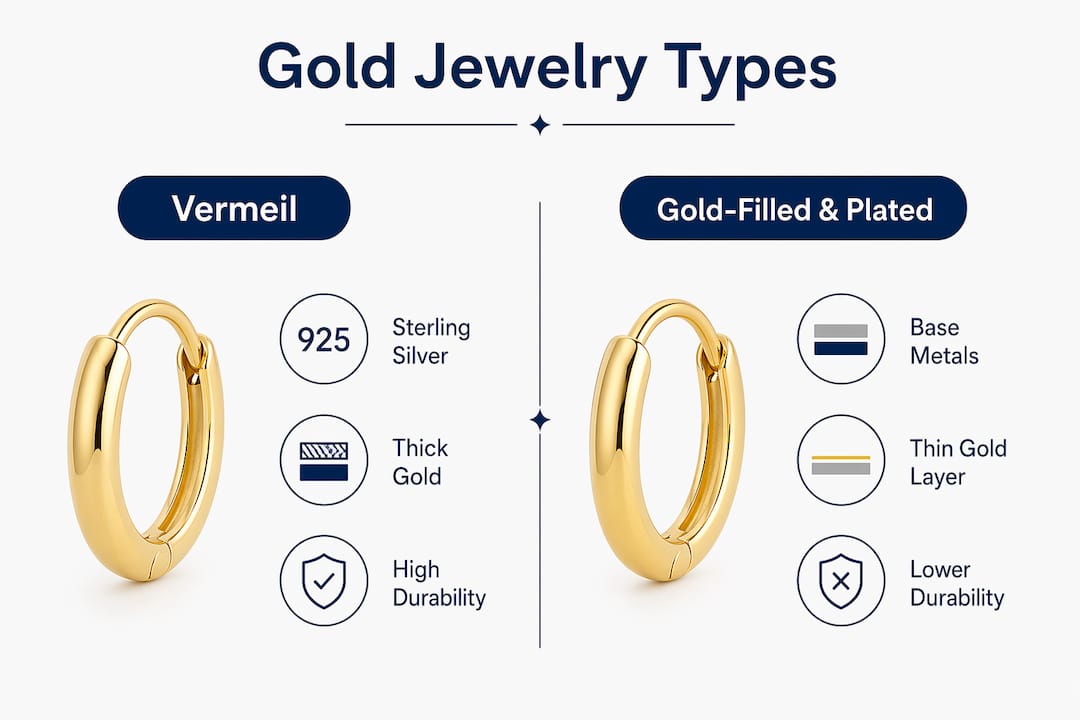
Vermeil is the highest standard of the three. FTC regulations require a sterling silver base of at least 92.5% silver, gold of at least 10K purity, and a minimum gold layer thickness of 2.5 microns. A piece marketed as vermeil without meeting these standards violates FTC guidelines. With proper care, vermeil can last one to three years of daily wear before showing signs of wear-through.
Gold-filled jewelry must have a mechanically bonded gold layer constituting at least 5% of the total metal weight. The base metal is typically brass or copper. Because the gold layer is bonded under heat and pressure rather than electroplated, gold-filled pieces are more durable than plated options and resist tarnishing better over time.
Gold-plated jewelry carries a very thin electroplated layer, typically around 0.175 microns. This makes it the least durable of the three categories. The gold layer wears off within weeks to months under daily wear, especially at friction points like clasps and inner bands. Gold-plated pieces are fine for occasional wear but not for everyday use.
| Category | Base metal | Gold thickness | Durability |
|---|---|---|---|
| Vermeil | Sterling silver (92.5%) | 2.5 microns minimum | 1 to 3 years daily wear |
| Gold-filled | Brass or copper | 5% of total weight | Several years with care |
| Gold-plated | Any base metal | ~0.175 microns | Weeks to months |
Pro Tip: When a retailer uses the word “vermeil” without specifying the base metal or gold thickness, ask directly. Legitimate sellers disclose both. If they cannot answer, treat the piece as gold-plated.
The FTC requires accurate disclosure of metal type, plating thickness, and purity. Any brand that blurs these distinctions is not just cutting corners on quality. It is operating outside legal standards.
Key gemstone terms and setting styles to know before you buy
Gemstone quality is evaluated through four primary attributes: clarity, cut, color, and carat weight. Understanding these terms lets you compare stones accurately and understand lab diamond pricing factors without relying on a salesperson’s summary.
Clarity refers to the presence of internal inclusions (crystals, feathers, clouds) and external blemishes (scratches, pits). The GIA clarity scale runs from Flawless (FL) to Included (I3). Eye-clean stones in the VS1 to SI1 range offer the best value for most buyers because inclusions are invisible without magnification.
Cut describes the proportions, symmetry, and polish of a stone, not its shape. A well-cut diamond reflects light back through the top of the stone, producing brilliance and fire. A poorly cut stone leaks light through the sides and bottom, appearing dull regardless of its clarity or color grade.
Color in white diamonds is graded on a D-to-Z scale, where D is colorless and Z shows visible yellow or brown tints. For lab-grown diamonds, diamond color grading follows the same GIA scale. Stones in the G-to-I range appear colorless to the naked eye and cost less than D-to-F grades.
Setting styles determine how a stone is held in the metal and directly affect appearance, security, and maintenance:
- Prong setting: Metal claws grip the stone at its girdle, maximizing light exposure and brilliance. Standard for solitaire engagement rings. Prongs can catch on fabric and require periodic tightening.
- Bezel setting: A metal rim encircles the stone completely. Offers the most protection for the stone and suits active lifestyles, though it reduces light entry compared to prong settings.
- Pavé setting: Small stones set closely together create a surface that appears paved with diamonds. Adds sparkle without a large center stone. Stones in pavé settings can loosen over time and require professional inspection.
- Halo setting: A circle of smaller stones surrounds a center stone, increasing its perceived size visually. A 0.75-carat center stone in a halo can appear as large as a 1-carat solitaire. The 6mm halo moissanite stud earrings from Icevaultatl are a practical example of this effect.
- Cluster setting: Multiple smaller stones grouped together to mimic a larger stone. Offers visual impact at lower cost but requires careful maintenance to keep all stones secure.
How to read jewelry stamps and hallmarks
Common jewelry stamp codes include 925 for sterling silver, 585 for 14K gold, 750 for 18K gold, and 999 for 24K gold. These numbers represent the parts-per-thousand purity of the metal. A stamp of 585 means 585 parts out of 1,000 are pure gold, which equals 58.5%, the exact composition of 14K gold.
Beyond purity stamps, jewelry carries several other marks worth knowing:
- GP (Gold Plated): Indicates a thin electroplated gold layer over a base metal. No thickness or purity standard is implied unless additional numbers appear.
- GEP (Gold Electroplated): Specifies the electroplating method. Often seen on costume jewelry and fashion pieces.
- HGE (Heavy Gold Electroplate): Suggests a thicker plating than standard GP, though the term has no strict FTC definition and should be verified.
- Hallmarks: Government or assay office stamps that certify metal purity. British hallmarks, for example, include the assay office symbol, purity mark, and date letter. American jewelry relies more on manufacturer stamps than government assay marks.
- Maker’s marks: A manufacturer’s registered symbol or initials, often found alongside purity stamps. These help trace a piece to its origin and can assist in authentication.
Authentication matters most when buying vintage or estate jewelry, where stamps are the primary evidence of metal content. A piece without any stamp is not automatically fake, but it requires additional testing to verify its composition.
Pro Tip: Always check the inside of a ring band or the back of a clasp for stamps. Marks on chains are often found on the clasp itself. A loupe or jeweler’s magnifier (10x) makes reading small stamps straightforward.
Materials and craftsmanship terms that affect quality
Understanding the materials behind a piece tells you how it will wear over time. An alloy is a metal mixture. Pure gold and pure silver are both too soft for daily wear, so jewelers mix them with harder metals. Gold is alloyed with copper, silver, zinc, or palladium depending on the desired karat and color. White gold, for example, is yellow gold alloyed with palladium or nickel, then typically coated with rhodium.
Key construction and material terms include:
- Rhodium plating: A thin layer of rhodium applied to white gold to enhance its bright white color and scratch resistance. Rhodium plating wears off over one to two years and requires replating, which is a standard jewelry service.
- Platinum: A naturally white, dense metal that does not require rhodium plating. Platinum is 95% pure in most fine jewelry (marked 950) and is heavier and more expensive than gold. It develops a patina over time rather than scratching away.
- Sterling silver: 92.5% pure silver alloyed with copper, marked 925. It tarnishes when exposed to air and sulfur compounds but polishes back easily. It is the required base metal for vermeil.
- 316L stainless steel: Contains 10 to 14% nickel, but the nickel is bound within a chromium oxide layer, making it safe for most sensitive skin. Durable, tarnish-resistant, and widely used as a base metal in fashion jewelry.
- Shank: The band portion of a ring that encircles the finger. A split shank divides into two strands near the setting. A tapered shank narrows toward the setting for a delicate look.
- Gallery: The underside of a ring setting, between the shank and the stone. An open gallery allows light to pass through the stone from below, increasing brilliance.
These terms appear in product descriptions across jewelry collections and directly signal construction quality when you know what to look for.
Key takeaways
Knowing jewelry terminology is the single most effective way to avoid overpaying, spot misrepresented products, and choose pieces that match your lifestyle and budget.
| Point | Details |
|---|---|
| Karat vs. carat | Karat measures gold purity on a 24-point scale; carat measures gemstone weight at 200 mg per unit. |
| Vermeil legal standard | Vermeil requires sterling silver base, 10K+ gold, and a minimum 2.5-micron gold layer under FTC rules. |
| Hallmark stamps | Stamps like 925, 585, and 750 verify metal purity and are the primary authentication tool for buyers. |
| Setting style impact | Prong settings maximize brilliance; bezel settings offer protection; halo settings increase perceived stone size. |
| Gold-plated durability | Gold-plated jewelry carries a layer of roughly 0.175 microns and wears off within weeks to months of daily use. |
Why jewelry vocabulary is the sharpest tool you own as a buyer
I have watched buyers walk away from a counter convinced they purchased vermeil, only to find the piece tarnishing within three weeks. The seller used the word “vermeil” on the tag, but the base metal was brass, not sterling silver. That is not a gray area. It is a violation of FTC standards, and it happens because most buyers do not know what vermeil actually requires.
The karat versus carat confusion is equally common and more costly. I have seen shoppers assume a “2-carat gold bracelet” means the bracelet contains two carats of gold purity, when carat in that context refers to gemstone weight, not metal purity at all. The sentence does not even make sense once you know the definitions, but without that knowledge, it sounds authoritative.
Hallmark stamps saved me from a poor purchase at an estate sale. A ring was presented as 18K gold, but the stamp inside the band read 585, which is 14K. The price reflected 18K value. Knowing that 750 is the correct stamp for 18K gold made the discrepancy immediately visible. That single piece of knowledge was worth more than any amount of general shopping advice.
Settings matter beyond aesthetics. A pavé band on an engagement ring worn during physical work will lose stones within months without regular professional maintenance. A bezel-set stone on the same ring would survive years of the same conditions. Choosing a setting that matches your lifestyle is not a style preference. It is a durability decision.
Use this vocabulary as a checklist, not background reading. Before any purchase, identify the metal category, verify the stamp, confirm the setting type, and ask for clarity on any term the seller uses that you cannot define precisely.
— ICEVAULT
Shop Icevaultatl with the vocabulary to back every decision
Icevaultatl lists every product with the terminology and specifications you now know how to read. Metal purity, stone weight, setting style, and base metal are disclosed clearly across the catalog, from lab-grown diamond studs to moissanite halo earrings set in 925 sterling silver. Every piece on the Icevaultatl storefront is described using the same FTC-standard language covered in this guide, so you can verify what you are buying before checkout. If you want to see how these terms apply to real products, browse the full collection and use your new vocabulary to evaluate each piece on its actual merits.
FAQ
What does karat mean in jewelry?
Karat measures gold purity on a scale of 24, where 24K is pure gold and 14K is 58.5% gold mixed with other metals. Higher karat gold is softer and more expensive per gram.
Is vermeil better than gold-plated?
Vermeil is significantly more durable than standard gold-plated jewelry. Vermeil requires a sterling silver base and a gold layer at least 2.5 microns thick under FTC rules, while gold-plated layers average around 0.175 microns.
What does the stamp 925 mean on jewelry?
The stamp 925 indicates sterling silver, meaning the metal is 92.5% pure silver. It is the required base metal for vermeil and the standard for fine silver jewelry.
What is a halo setting?
A halo setting surrounds a center stone with a ring of smaller stones, increasing the piece’s visual size and sparkle. A 0.75-carat center stone in a halo can appear comparable in size to a 1-carat solitaire.
How do I know if a piece is gold-filled or gold-plated?
Check the stamp: gold-filled pieces are often marked GF or 1/20 followed by the karat (such as 1/20 14K GF). Gold-plated pieces are marked GP or GEP. Gold-filled jewelry has a mechanically bonded gold layer equal to at least 5% of total metal weight, making it far more durable than plated alternatives.