
Two diamonds sit side by side. Same carat weight, same sparkle to the naked eye, but a $1,200 price gap between them. That scenario is more common than most shoppers realize. Lab diamond pricing factors are rarely explained in full at the point of sale, and retailers depend on that confusion. Understanding what actually drives cost, from cut quality and carat weight to certification, market supply, and where you buy, puts you in a far stronger position to find a stone that delivers real value without overpaying.
Table of Contents
- Key takeaways
- Lab diamond pricing factors you need to understand first
- How market forces shape lab diamond prices in 2026
- Why certification changes what you pay
- Real price ranges for 2026: what to expect by carat and shape
- Evaluating cost versus value and resale potential
- My honest take on buying lab diamonds
- Shop lab diamonds with transparent pricing at Icevaultatl
- FAQ
Key takeaways
| Point | Details |
|---|---|
| Cut quality drives sparkle most | An Excellent cut grade matters more than a slightly higher carat weight for visual impact and price efficiency. |
| Prices dropped sharply since 2020 | Manufacturing advances have pushed lab diamond prices down roughly 74%, making 2026 a buyer’s market. |
| Certification protects your investment | IGI or GIA certified stones offer grading transparency that removes pricing uncertainty and supports resale value. |
| Mall pricing can be 3x fair market | Direct-to-consumer retailers consistently undercut traditional mall jewelers by hundreds to thousands of dollars. |
| Resale value is low by design | Lab diamonds typically return only 10% to 30% of retail price, so buy for personal value, not as an asset. |
Lab diamond pricing factors you need to understand first
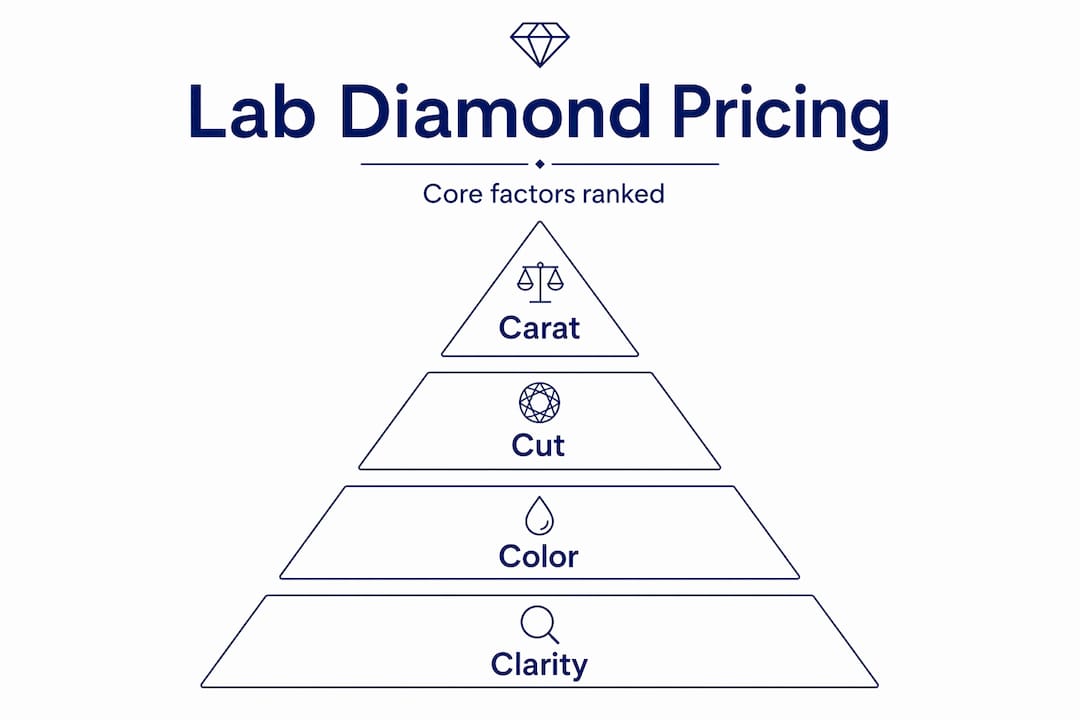
The Four Cs sit at the core of every lab diamond pricing breakdown. Cut, color, clarity, and carat weight each play a distinct role, and knowing how they interact helps you spend smarter.
Cut is the most underestimated factor. Cut quality directly affects how much a diamond sparkles, and poorly cut stones look dull regardless of their other grades. An Excellent or Ideal cut commands a price premium that is genuinely worth paying. A diamond graded Very Good cut at the same carat weight might cost 10% to 15% less, but the visual difference is real under any light.
Carat weight is the single biggest price driver, but the relationship is not linear. Price increases exponentially at certain thresholds, specifically at the 1, 1.5, 2, and 3 carat marks. A 0.95 carat stone can cost significantly less than a 1.0 carat stone with nearly identical visual size. Buying just under a weight threshold is one of the most reliable lab diamond cost savings strategies available.
Color grades run from D (colorless) to Z (visibly yellow). For lab diamonds, the practical sweet spot sits at G or H. These grades face up white in most settings, yet they cost noticeably less than D, E, or F color stones. The optimal value grades of Excellent cut, VS clarity, and G-H color consistently deliver the best combination of appearance and price.
Clarity follows a similar logic. Eye-clean stones in the VS1, VS2, or even SI1 range look flawless to the naked eye and cost far less than Internally Flawless or VVS1 grades. Unless you are buying for documentation purposes or resale, paying for microscopic perfection rarely improves the actual wearing experience.
- D color costs roughly 20% to 30% more than G for identical specs
- SI1 clarity can be 15% to 25% cheaper than VS1, often with no visible difference
- Excellent cut adds value; avoid Very Good or Good cut grades even to save money
- Carat weight thresholds create the steepest price jumps in any lab diamond cost breakdown
Pro Tip: When comparing two stones, prioritize Excellent cut first, then choose the highest color and clarity grade your budget allows. A beautifully cut G/VS2 stone will outperform a poorly cut D/VVS1 every time.
How market forces shape lab diamond prices in 2026
Lab diamond pricing is not static. The market has shifted dramatically over the past six years, and understanding why helps you read current prices with more confidence.

CVD technology now reduces diamond growth time from weeks to days, increasing supply at a pace that has permanently altered the pricing structure. That surge in supply has pushed lab diamond prices down about 74% since 2020. A stone that retailed for $3,000 in 2021 might list for under $800 today. That is not a sale. That is the new market reality.
The global lab grown diamond market is projected to grow at a 9.6% compound annual growth rate, reaching $59.2 billion by 2032. More production capacity means more stones, which means further downward price pressure. For buyers, 2026 is genuinely one of the best times to purchase a lab diamond purely on price grounds.
“Retail mall jewelers often mark up lab diamonds by 300% to protect natural diamond sales, creating pricing that is three times what the market actually supports.” — TheCaratCut, 2026
That markup is not a minor rounding difference. It represents thousands of dollars on larger stones. Traditional retailers built their pricing models around natural diamonds, where supply is controlled and margins are protected. Lab diamonds do not fit that model, so many brick-and-mortar stores either avoid them or inflate prices to make natural stones look more competitive by comparison.
Retailer transparency also factors into pricing. Direct-to-consumer platforms publish grading details, certificate numbers, and comparison tools that make it easy to verify you are paying a fair price. That transparency is itself a pricing signal. If a retailer cannot or will not show you the grading report, the price probably does not reflect market value.
Why certification changes what you pay
Grading certification does more than confirm quality. It changes the entire transaction dynamic by converting a subjective purchase into a verifiable one.
IGI and GIA are the two most recognized certification bodies for lab diamonds. Certified stones command premiums because grading uncertainty is removed. You know exactly what you are buying. An uncertified stone might look similar and carry a lower price tag, but without documentation you have no way to confirm the grades being claimed by the seller.
The practical difference between IGI and GIA for lab diamonds is worth knowing. GIA began certifying lab diamonds in 2020 and carries strong brand recognition, particularly for resale. IGI has certified lab diamonds longer and currently grades a higher volume of them, making IGI reports the more common reference in the market. Either certification provides meaningful buyer protection.
Here is what to look for when reviewing a grading report:
- A unique report number that matches the laser inscription on the girdle of the stone
- Grades for all four Cs stated clearly, with no ranges or approximations
- The growth method listed (CVD or HPHT)
- A diagram showing inclusion locations for clarity grades below VVS2
- Verification through the certifier’s public online database
Pro Tip: Use the IGI public report database to independently verify any stone’s grading before purchase. Cross-referencing the certificate number takes about 60 seconds and can reveal pricing discrepancies of hundreds of dollars on identical stones.
Uncertified stones are not always lower quality. But the risk of inaccurate seller grading is real, and that risk carries a financial consequence. When a seller claims a stone is VS1/G without documentation, you are essentially taking their word for it.
Real price ranges for 2026: what to expect by carat and shape
Concrete numbers make this practical. Here is a realistic lab diamond pricing breakdown for round brilliant stones in 2026, based on Excellent cut, G-H color, and VS1-VS2 clarity:
| Carat weight | Good deal range | Fair retail range | Mall pricing |
|---|---|---|---|
| 1.0 ct | $400 to $600 | $700 to $900 | $1,500 or more |
| 1.5 ct | $900 to $1,200 | $1,300 to $1,700 | $3,000 or more |
| 2.0 ct | $1,400 to $1,900 | $2,000 to $2,600 | $5,000 or more |
| 3.0 ct | $2,500 to $3,500 | $3,800 to $4,500 | $8,000 or more |
Source: TheCaratCut Lab Diamond Price Guide, 2026
The gap between a good deal and mall pricing on a 3 carat stone can exceed $5,000. That is not a marginal difference. It reflects the structural cost of buying from a retailer that prices lab diamonds to protect its natural diamond margins.
Shape also plays a direct role in cost. Fancy shapes like ovals and pears typically run 10% to 15% less than round brilliants of equal quality, simply because round remains the most in-demand shape and commands a scarcity premium even in lab diamonds. An oval at 1.5 carats delivers a larger face-up appearance than a round at the same weight, costs less, and is no less optically impressive when cut well.
You can also explore fine jewelry comparisons to see how pricing scales across different styles and settings at other reputable retailers.
The practical takeaway from any price comparison on lab diamonds: use the table above as a benchmark. If a retailer’s asking price for a 1 carat, G/VS1, Excellent cut round falls above $1,200 in 2026, you are in overpriced territory.
Evaluating cost versus value and resale potential
Price is what you pay. Value includes what you keep. Those two numbers are different for lab diamonds, and confusing them leads to buyer’s remorse.
Lab diamonds typically return only 10% to 30% of their original retail price when resold, compared to natural diamonds which retain 20% to 60%. That gap is significant. Lab diamond resale considerations matter most for buyers who view jewelry as a store of value. If you are buying a stone to wear, enjoy, and pass down, resale matters far less. If you need liquidity from the purchase, lab diamonds are not the right choice.
That said, several factors reduce resale loss:
- Larger stones (2 carats and above) tend to hold more absolute resale value than smaller ones
- IGI or GIA certification makes resale transactions faster and more credible
- Excellent cut grades attract more secondary buyers than lower cut grades
- Stones set in quality metals (14k or 18k gold) resell better than sterling silver settings
The most common way buyers overpay is through brand premiums at well-known retailers. You are often paying for a name, a physical store, and a box, not a better diamond. Using the IGI database to compare stones across multiple retailers for identical certificate specs removes that brand premium instantly.
Pro Tip: Search for lab diamonds by IGI certificate number across multiple platforms. If the same stone specification is available at a 30% lower price elsewhere, the brand premium is the only thing you are paying for.
The most grounded approach to lab diamond value assessment: treat the cost savings versus natural diamonds as your primary financial win, not future resale. Lab diamonds offer 70% to 80% savings at purchase compared to comparable natural stones. That is the real financial argument, not appreciation.
My honest take on buying lab diamonds
I’ve spent years watching buyers make the same avoidable mistakes. The most common one is fixating on carat weight and ignoring cut. A 1.5 carat stone with a mediocre cut looks worse in person than a 1.2 carat Excellent cut. You are paying for size that does not show up as brilliance.
Mall pricing is a trap I’ve seen catch well-intentioned buyers repeatedly. The 300% markup is not exaggeration. Walk into a major national chain and ask for a 1 carat lab diamond with an IGI certificate. Then check the same certificate specs online from a direct seller. The price difference will speak for itself.
The resale truth is uncomfortable for some buyers. Lab diamonds are not investments. I’ve seen people justify a premium purchase by telling themselves they can sell it later. Resale values of 10% to 30% of retail mean that is almost never a practical strategy. Buy the stone because you love it. Buy it certified, buy it well-cut, and buy it from a transparent seller. Those three choices protect your purchase better than any resale speculation.
My recommended approach: set a firm budget, identify your minimum cut grade (Excellent only), choose G or H color, select VS2 or eye-clean SI1 clarity, and use certificate comparison tools to find the best price for those specs. That process consistently delivers stones that look stunning and cost a fraction of what a mall would charge.
— ICEVAULT
Shop lab diamonds with transparent pricing at Icevaultatl
At Icevaultatl, every lab diamond is priced to reflect actual market value, not inflated retail margins. The collections include IGI certified stones across a full range of carat weights and quality grades, with clear specifications listed for every product. Whether you are shopping for 1 CTW diamond studs in D color or exploring the full range of lab diamond engagement rings, you will find direct-to-consumer pricing that removes the brand markup. The lab diamond stud earring collection also offers entry-level options without compromising on cut quality or certification. Transparent product descriptions, certificate details, and real pricing make it easy to compare and buy with confidence.
FAQ
What is the biggest factor in lab diamond pricing?
Carat weight has the largest single impact on price, but cut quality determines how good the stone actually looks. Excellent cut, G-H color, and VS clarity consistently deliver the best visual value per dollar.
Why are lab diamond prices so much lower than a few years ago?
CVD manufacturing advances have made production faster and more scalable, flooding the market with supply. Prices have dropped roughly 74% since 2020, making 2026 a strong buyer’s market.
Do lab diamonds hold their resale value?
No. Lab diamonds typically sell for 10% to 30% of original retail on the secondary market. They are not investment assets, so purchase decisions should focus on personal value rather than future returns.
Is IGI or GIA certification better for lab diamonds?
Both provide reliable grading. GIA carries stronger brand recognition for resale, while IGI certifies a higher volume of lab diamonds and is more commonly found across direct-to-consumer retailers. Either certificate protects your purchase.
How much should I pay for a 1 carat lab diamond in 2026?
A fair retail price for a 1 carat, Excellent cut, G color, VS2 clarity round brilliant is roughly $700 to $900. Good deals fall between $400 and $600. Prices above $1,200 for this spec typically reflect retailer markup rather than stone quality.