
Buying a diamond should feel exciting, not exhausting. Yet most shoppers hit a wall fast: claims about ethical sourcing contradict each other, price ranges vary wildly, and the difference between a lab diamond and a mined stone is still a mystery to many buyers. You deserve a clear path through all of it. This guide breaks down every stage of the lab diamond buying process, from understanding what you actually want to verifying that your final purchase lives up to its promises. No jargon, no vague advice, just concrete steps backed by current industry data.
Table of Contents
- Understand why more buyers are choosing lab diamonds
- Prepare for the lab diamond shopping journey
- Step-by-step: How to shop for a lab diamond with confidence
- Evaluate ethics, sustainability, and authenticity claims
- The hidden challenges (and rewards) in lab diamond shopping
- Find your perfect lab diamond or custom jewelry with Icevault ATL
- Frequently asked questions
Key Takeaways
| Point | Details |
|---|---|
| Lab diamond demand is booming | More buyers are seeking affordable, ethical options with 61% of engagement rings now featuring lab stones. |
| Plan early and list priorities | Research, budgeting, and involving your partner can streamline the shopping process and avoid last-minute stress. |
| Follow a stepwise approach | Move from research and shortlisting to comparing certifications and verifying authenticity before final purchase. |
| Scrutinize ethics and sustainability | Not all claims are equal—review details about sourcing, certification, and environmental impact for true transparency. |
| Ask questions, personalize | Savvy shoppers get the best value and peace of mind by demanding transparency and customizing their jewelry choices. |
Understand why more buyers are choosing lab diamonds
Lab diamond sales have shifted from a niche category to a mainstream choice in just a few years. The numbers are striking. Lab-grown diamonds now account for 61% of all engagement ring purchases in 2025, with average spending sitting at $4,600 per ring. That is not a trend. That is a market transformation.
So what is driving so many buyers toward lab-grown stones?
- Affordability. Lab diamonds typically cost 50 to 70 percent less than comparable mined stones, which means you can get a larger carat weight or a more intricate setting for the same budget.
- Ethical sourcing. Many buyers want to avoid the social and environmental concerns tied to traditional diamond mining, including labor conditions and land disruption.
- Customization. Lab diamonds are available in a wider range of cuts, colors, and sizes, making it easier to find or design exactly what you want.
- Identical physical properties. A lab diamond is not a simulant. It is not cubic zirconia or moissanite. It is chemically, optically, and physically identical to a mined diamond. The only difference is where it was created.
The diamond industry ethics conversation has pushed many consumers to ask harder questions before they buy. Lab diamonds offer a direct answer to some of those questions, though not all of them, which we will address later in this guide.
If you are already browsing lab diamond engagement options, you are in good company. The shift toward lab-grown is not about compromise. For most buyers today, it is simply the smarter choice.
Prepare for the lab diamond shopping journey
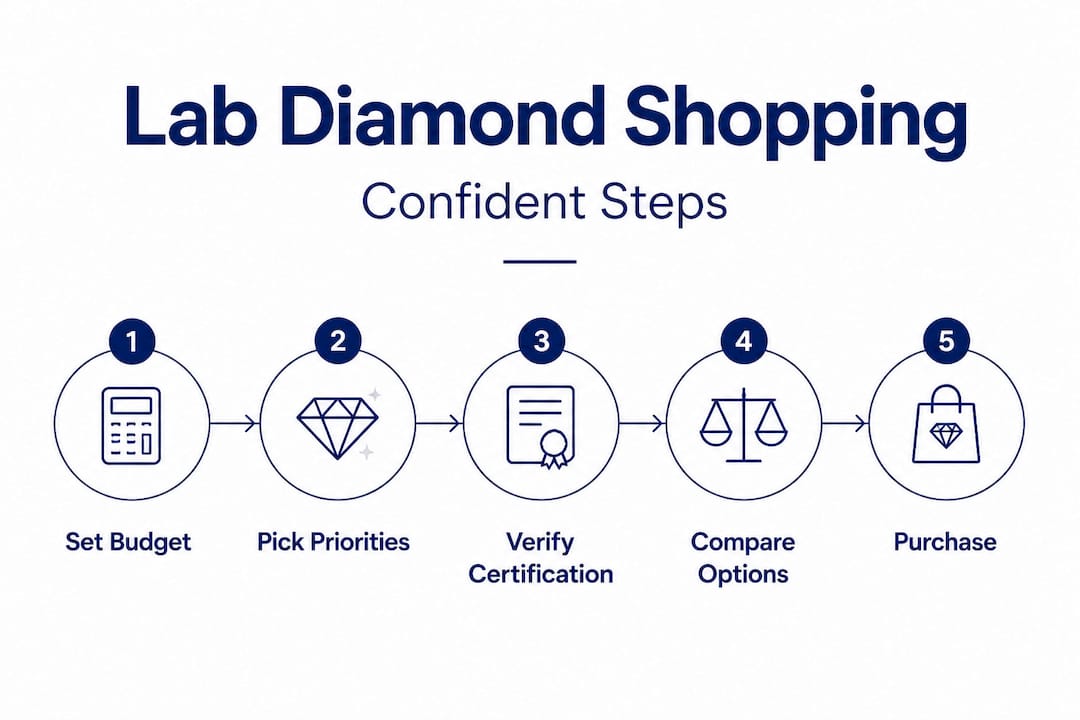
Getting organized before you start browsing saves time and prevents decision fatigue. The good news is that most buyers do not need months to figure this out. 77% of buyers complete their research and purchase within four months, and 79% of ring recipients are directly involved in choosing the ring. That means the days of solo surprise proposals are largely behind us, and planning together is now the norm.
Start with your budget. Be specific. Knowing your ceiling prevents you from falling in love with a stone that is out of reach. Lab diamonds give you more flexibility here, but a clear number still keeps your search focused.
Clarify your priorities. Ask yourself which matters most: carat size, cut quality, color grade, metal type, or setting style. You probably cannot max out every category, so ranking them helps you make faster decisions.

Involve your partner early. This is not just emotionally smart. It is practical. When the recipient is part of the process, you avoid costly returns and resizing headaches.
Here is a quick comparison to help you decide between online and in-person shopping:
| Factor | Online shopping | In-person shopping |
|---|---|---|
| Selection | Broader, often better pricing | Limited to store inventory |
| Convenience | Shop anytime, from anywhere | Requires travel and scheduling |
| Inspection | Relies on photos and videos | See the stone directly |
| Customization | Often more flexible | Depends on the jeweler |
| Return policy | Varies widely | Usually easier to resolve |
| Delivery time | 1 to 3 weeks typical | Take home same day |
Build a wish list. Separate your must-haves from your nice-to-haves. For example, a round cut in E or F color might be non-negotiable, while a specific band width is flexible. This list becomes your filter when you start comparing options.
Pro Tip: If you are shopping for earrings as a gift or personal purchase, pieces like 5mm lab diamond studs or 3mm diamond stud earrings are excellent starting points because they involve fewer variables than rings and give you a feel for quality at a lower price point.
Plan your timeline carefully. If you need a piece for a specific date, work backward. Factor in production time for custom orders (sometimes two to four weeks), shipping, and any resizing. Rushing this process is one of the most common mistakes buyers make.
Step-by-step: How to shop for a lab diamond with confidence
Once you are organized, follow this sequence to move from research to purchase without second-guessing yourself at every turn.
-
Research sellers and collections. Start with jewelers who specialize in lab diamonds and clearly disclose their sourcing and certification practices. Generic jewelry stores often carry lab diamonds as an afterthought. Specialists offer better selection and more knowledgeable staff.
-
Shortlist two to four options. Do not compare 20 stones at once. Narrow your list based on your wish list criteria. This keeps the decision manageable.
-
Ask direct questions. Contact each seller and ask: What certification does this stone carry? What is the return window? Can you provide a grading report? A seller who cannot answer these questions clearly is a red flag.
-
Evaluate certification. Look for stones graded by IGI (International Gemological Institute) or GIA (Gemological Institute of America). A certified diamond ring comes with a grading report that documents carat, cut, color, and clarity. This is your proof of quality and your protection if there is ever a dispute.
-
Inspect the stone. 64% of engagement rings are still purchased in person, which tells you that seeing a stone firsthand still matters to most buyers. If you are buying online, request high-resolution video or a 360-degree view. Reputable sellers provide this without hesitation.
-
Review return and warranty terms. Read the fine print before you pay. A solid return window (30 days minimum) and a clear warranty for setting defects are standard at reputable jewelers. If these are missing or vague, keep looking.
-
Make your purchase. Once you have verified the certification, reviewed the terms, and confirmed the stone matches your priorities, buy with confidence. Hesitation at this stage usually means you have not fully resolved one of the earlier steps.
Here is a quick reference table to keep your evaluation organized:
| Evaluation factor | What to check | Why it matters |
|---|---|---|
| Certification | IGI or GIA grading report | Confirms quality claims |
| Return policy | Minimum 30-day window | Protects your investment |
| Customization options | Setting, metal, engraving | Personalizes the piece |
| Delivery timeline | Production plus shipping | Avoids deadline stress |
| Seller transparency | Clear sourcing disclosures | Builds trust |
Following diamond shopping best practices means treating this like any major purchase. Research, verify, and document everything. The process does not need to be stressful if you follow a clear sequence and work with sellers who welcome your questions.
Pro Tip: When comparing two similar stones, ask the seller to walk you through the grading report line by line. A seller who can do this confidently is one you can trust. One who deflects or rushes you is not.
Browse the full engagement ring collection to get a sense of what certified, well-documented lab diamond pieces actually look like at different price points.
Evaluate ethics, sustainability, and authenticity claims
Here is where many buyers get tripped up. The phrase “ethically sourced” appears on nearly every lab diamond listing, but it is not a regulated term. Anyone can use it. Your job is to look past the marketing language and ask specific questions.
“Sustainability and ethics claims are not black and white. Lab diamond production can have lower CO2 emissions than traditional mining, but the social and environmental picture is genuinely complex.” National Geographic
What does this mean in practice? A few key points:
- Energy source matters. A lab in a region powered by renewable energy produces significantly fewer emissions per carat than one running on coal. Ask where the lab is located and what energy it uses.
- EU-based labs tend to have stricter environmental standards and lower carbon footprints per carat compared to labs in regions with less regulation.
- Social complexity. Traditional diamond mining supports the livelihoods of millions of workers in developing countries. Lab diamonds do not carry conflict diamond risks, but they also do not directly support those communities. Neither choice is purely good or bad.
- Green marketing is not a certification. Words like “eco-friendly,” “sustainable,” and “conflict-free” should be backed by third-party verification, not just seller copy.
When you are evaluating a seller, ask these specific questions:
- Where is the diamond grown, and what energy source powers the facility?
- Does the lab hold any environmental certifications?
- Can you provide documentation of the production process?
- Is the stone certified by an independent gemological body?
Sellers who offer authentic diamond stud options with clear documentation and grading reports are already ahead of most. Transparency is the baseline, not a bonus feature.
Review lab diamond sustainability claims from independent sources before you take any seller’s word for it. Your purchase decision should be based on verified facts, not polished marketing.
The hidden challenges (and rewards) in lab diamond shopping
After going through every practical step, it is worth stepping back and saying something that most buying guides skip: lab diamond shopping is more nuanced than the branding suggests, and that is actually a good thing for informed buyers.
The market has matured fast. Prices have dropped significantly over the past three years, which is great for your budget but means resale values have also declined. If you are buying a lab diamond as an investment, recalibrate your expectations. If you are buying it because you want a beautiful, ethically considered piece of jewelry at a fair price, you are in exactly the right place.
What really separates savvy buyers from frustrated ones is the willingness to ask hard questions. Not just about the stone itself, but about the seller’s practices, the certification body’s reputation, and the actual production conditions behind the “eco” label. Green buzzwords are easy to print. Documented evidence takes more effort to produce, and that effort is exactly what you should demand.
Real personalization and peace of mind come from understanding each choice you make, not from reacting to whatever trend is dominating social media this season. Engagement and special occasion jewelry are deeply personal. Your timeline, your budget, and your values should drive the decision, not external pressure.
More on custom lab rings is worth exploring if you want a piece that reflects your specific preferences rather than a catalog default. Customization is one of the strongest arguments for lab diamonds, and the best sellers make it accessible without adding weeks to your timeline.
The reward for doing this work carefully is real. You end up with a piece you fully understand, from the carbon atoms in the stone to the terms of your warranty. That kind of clarity is rare in luxury retail, and it is worth pursuing.
Find your perfect lab diamond or custom jewelry with Icevault ATL
You have done the research. You know what to look for, what questions to ask, and what claims to verify. Now it is time to put that knowledge to work.
Icevault ATL offers a curated selection of certified lab diamond jewelry, including rings, studs, and custom designs built for engagement, gifts, and everyday wear. Every piece comes with clear documentation, competitive pricing, and the kind of product detail that informed buyers actually need. Whether you prefer to shop engagement rings or start smaller with a pair of explore lab-grown studs, the platform is built to support both first-time buyers and experienced collectors. Flexible options, real certifications, and transparent sourcing make Icevault ATL a logical next step for anyone ready to buy with confidence.
Frequently asked questions
How long does the lab diamond shopping process usually take?
Most buyers complete their research and purchase within four months or less, though custom pieces or shipping can extend the timeline. 77% of buyers finish the entire process in that window.
Are all lab-grown diamonds truly ethical and environmentally friendly?
Not automatically. While lab diamonds often carry a lower carbon footprint than mined stones, the actual ethical and environmental benefits depend heavily on the producer’s energy source and level of transparency.
Do lab-grown diamonds hold their value like mined diamonds?
Resale values for lab-grown diamonds are generally lower than for mined diamonds due to wider availability and ongoing price drops in the lab diamond market.
Is in-person shopping better than buying lab diamonds online?
Most buyers still choose to buy in person to see diamonds firsthand, but online shopping offers broader selection and often better pricing. 64% of engagement ring purchases still happen in-store.
What should I look for when checking lab diamond certification?
Verify third-party grading from IGI or GIA, and confirm that the report matches the stone’s carat, cut, color, and clarity exactly as described by the seller.