
Checking diamond quality at home means applying physical tests and visual evaluations to determine authenticity and basic grading factors before committing to a purchase. The fog test, water test, and visual inspection of the 4Cs framework give any buyer a reliable starting point. GIA and AGS certifications remain the gold standard for final verification, but home tests catch obvious fakes and quality red flags fast. Lab-grown diamonds are chemically identical to natural diamonds and pass all standard home tests the same way mined stones do, which means these methods confirm diamond composition, not origin.
How to check diamond quality at home: understanding the 4Cs first
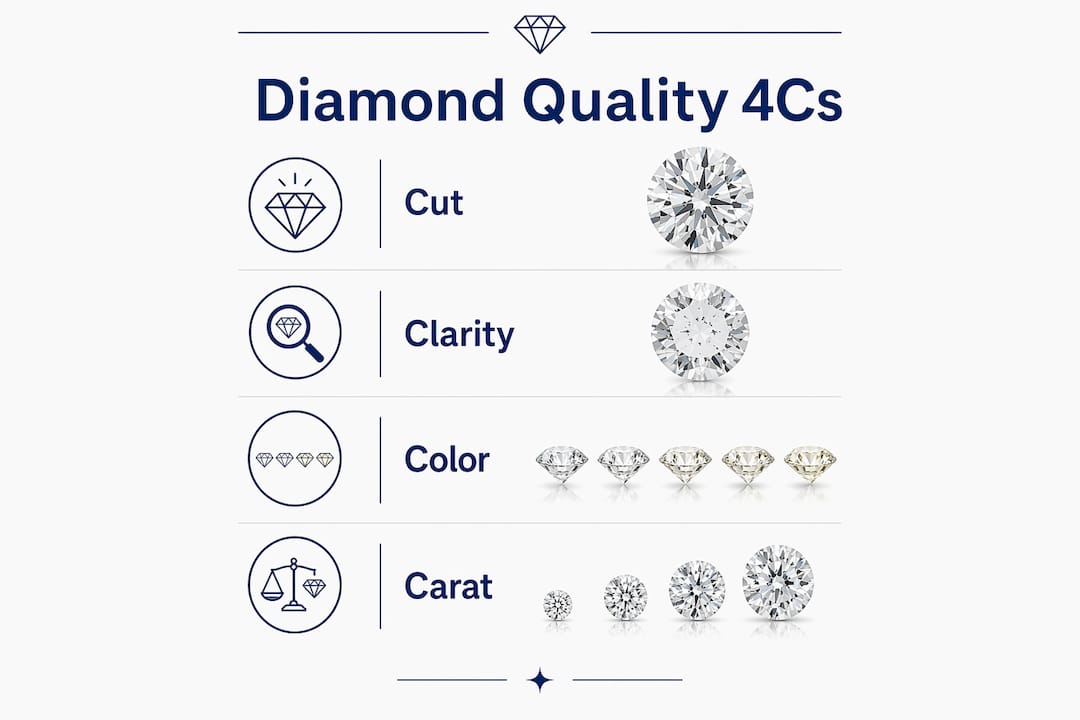
Before running any test, you need to understand what you are actually evaluating. The 4Cs — cut, clarity, color, and carat weight — are the four attributes that define a diamond’s quality and market value. Knowing what each one means lets you interpret what you see during any home inspection.
Cut is the most critical factor affecting how a diamond looks. Cut quality drives brilliance more than any other attribute, and a well-cut diamond with lower clarity or color grades will often outperform a higher-graded stone with poor proportions. Cut proportions including depth percentage, table percentage, crown angle, and pavilion angle all affect how light travels through the stone and exits as sparkle.
Clarity refers to the presence of internal inclusions or external blemishes. The industry uses the term “eye-clean” to describe stones where inclusions are not visible to the naked eye at normal viewing distance. Grades from FL (flawless) down to SI2 (slightly included) are generally eye-clean, while I1 and below show visible flaws without magnification.
Color in white diamonds is graded on a D-to-Z scale, where D is colorless and Z shows a visible yellow or brown tint. Subtle differences between adjacent grades are nearly impossible to detect without a comparison stone, but color grading affects value significantly across the scale.
Carat weight measures mass, not physical size. Carat measures diamond weight, and two diamonds of identical carat weight can look noticeably different in diameter depending on how they are cut. Buying a stone just below a major weight threshold like 0.90ct instead of 1.00ct saves 15 to 20% with no visible size difference.
Pro Tip: Prioritize cut grade above all other factors when buying. A D-color, FL-clarity diamond with a poor cut will look duller than an H-color, VS2 stone with an Excellent cut.
Which simple tests reliably verify if a diamond is real?
These four tests require no specialized equipment and deliver results in minutes. They work by exploiting physical properties unique to diamonds: extreme thermal conductivity and high density.
-
Fog test. Breathe on the stone as you would fog a mirror. A real diamond disperses heat so rapidly that condensation disappears almost instantly. The fog test identifies 94% of standard cubic zirconia simulants because fakes retain fog for two to four seconds. Repeat the test twice to rule out ambient temperature effects.
-
Water test. Fill a glass with water and drop the loose stone in. A real diamond sinks immediately because its density is approximately 3.5 g/cm³. Most simulants including glass and cubic zirconia are lighter and either float or sink more slowly. This test only works with loose stones, not mounted jewelry.
-
Flashlight or sparkle test. Hold the stone under a single-point light source like a phone flashlight in a darkened room. A real diamond reflects white light and produces small rainbow flashes from its facets. Cubic zirconia throws large, colorful rainbow patterns across the room. Moissanite produces a distinctive doubling effect visible under magnification, where facet edges appear doubled due to its birefringent crystal structure.
-
Dot or read-through test. Place the stone flat-side down over a small black dot drawn on white paper. Look straight down through the table facet. A real diamond refracts light so strongly that you cannot read the dot or see a clear circle. If you see the dot clearly or a distorted circular reflection, the stone is likely glass or cubic zirconia.
At-home tests rely on physical properties like density and thermal conductivity that no common simulant fully replicates. These tests do not require lab equipment and produce results you can interpret immediately.
Pro Tip: Run at least three tests before drawing a conclusion. No single home test is definitive on its own. Consistent results across the fog, water, and dot tests give you much stronger confidence.
How to visually assess diamond quality without a professional report
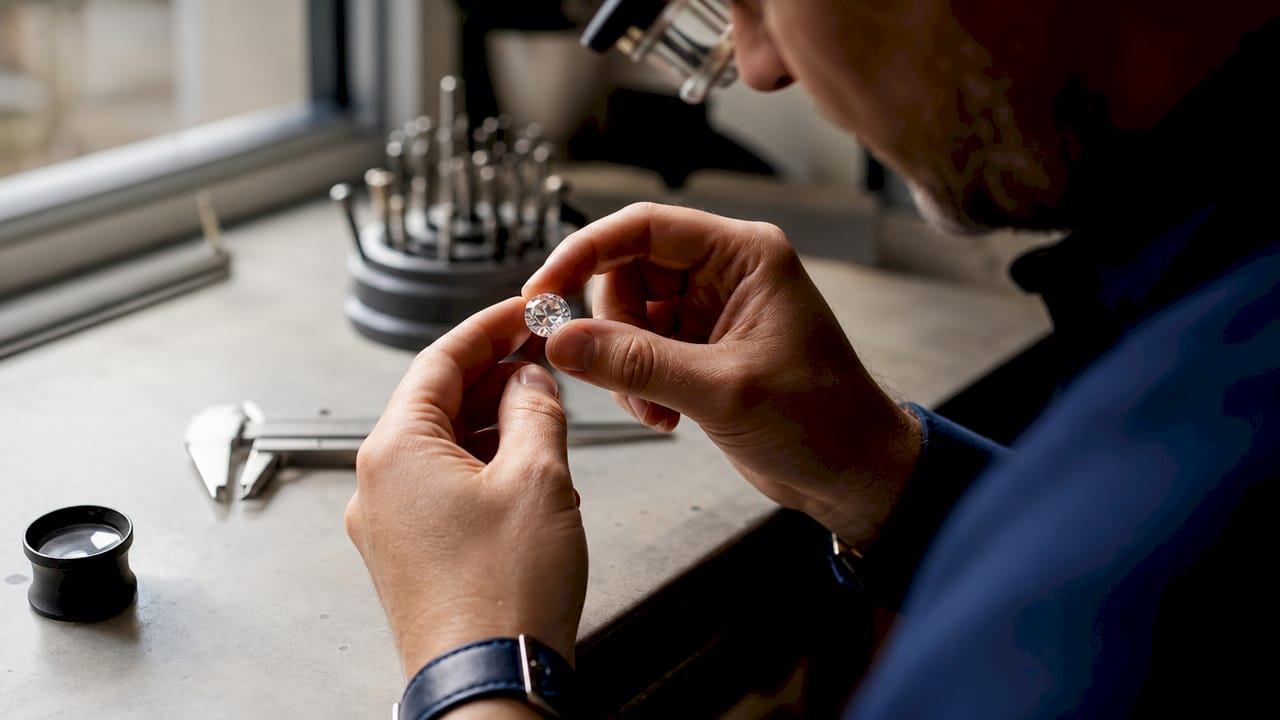
Visual assessment at home covers cut quality, clarity, color, and size perception. You need a 10x loupe or a macro-capable smartphone camera, a white sheet of paper, and a single directional light source.
Evaluating cut quality visually:
- Hold the diamond face-up under a single light and look for a bright, symmetrical pattern of light and dark areas called the “hearts and arrows” pattern in ideal cuts.
- Rotate the stone slowly. A well-cut diamond maintains consistent sparkle from multiple angles. Dead zones or dark patches indicate poor proportions.
- Check the girdle (the stone’s edge) for uneven thickness. An extremely thin girdle chips easily; an extremely thick one wastes carat weight and makes the stone look smaller than its weight suggests.
Checking clarity with magnification:
- Use a 10x loupe or set your phone camera to maximum zoom with macro mode enabled. View the stone under a bright, focused light.
- Look for black carbon spots, white feathers (fractures), or cloudy areas inside the stone. Position the light at different angles because some inclusions only appear under specific lighting.
- Visual inspection prevents costly mistakes by catching obvious flaws, but it cannot replace a grading report for borderline clarity grades.
Assessing color at home:
- Place the diamond table-down on a white piece of paper in natural daylight. Color is easiest to detect from the side profile, not the face-up view.
- Compare it against a known reference stone if possible. Color differences between adjacent grades like G and H are nearly invisible in isolation but become apparent side by side.
Understanding size versus carat:
- Measure the stone’s diameter with a millimeter gauge or a printed diamond size chart. A 1.00ct round brilliant should measure approximately 6.5mm in diameter. If a stone is sold as 1.00ct but measures 5.8mm, it may be cut too deep, hiding weight in the base rather than the face.
| Visual check | What to look for |
|---|---|
| Cut quality | Symmetrical sparkle, no dark zones, even girdle thickness |
| Clarity | No visible black spots, feathers, or cloudiness under 10x magnification |
| Color | Faint yellow or brown tint visible from the side profile on white paper |
| Size vs. carat | Diameter matches published millimeter standards for stated carat weight |
What are common mistakes when checking diamonds at home?
Home testing has real limits, and knowing where methods fail protects you from false confidence.
-
Thermal testers fail with moissanite. Standard thermal conductivity testers register moissanite as diamond because both materials conduct heat at similar rates. Thermal testers misidentify moissanite consistently, and only a multi-tester device that also measures electrical conductivity can separate the two. If you are comparing moissanite versus diamond, read the full comparison guide before testing.
-
Scratch tests damage stones. Some sources suggest scratching glass to test hardness. This risks chipping the girdle of a real diamond and proves nothing definitive since several simulants also scratch glass.
-
Not all certifications are equal. GIA (Gemological Institute of America) and AGS (American Gem Society) produce the most consistent and conservative grading reports. GIA and AGS certifications include laser inscriptions that link the physical stone to its official document. Reports from lesser-known labs often inflate grades, making a stone appear higher quality than it is.
-
Relying on a single test. Each home test addresses one property. The fog test checks thermal conductivity. The water test checks density. No single test covers all simulants. A multi-test approach is the minimum standard for reliable at-home differentiation.
For any purchase above $1,000, professional appraisal from a GIA-certified gemologist is the only way to confirm grading accuracy. Home tests screen out obvious fakes. They do not grade quality.
When home results are inconclusive, the stone shows unusual optical behavior, or the seller cannot provide a GIA or AGS report, take the stone to a certified appraiser. The cost of a professional appraisal is typically $50 to $150 and is worth every dollar on a significant purchase.
Key takeaways
Reliable at-home diamond evaluation requires combining physical tests for authenticity with visual inspection of cut, clarity, color, and carat weight, then confirming results with GIA or AGS certification for any high-value purchase.
| Point | Details |
|---|---|
| Prioritize cut quality | A well-cut diamond outperforms higher-graded stones with poor proportions in visible brilliance. |
| Use multiple home tests | Fog, water, and dot tests together give far stronger authenticity confidence than any single method. |
| Thermal testers miss moissanite | Only multi-tester devices measuring electrical conductivity reliably separate moissanite from diamond. |
| Visual inspection has limits | Home checks catch obvious flaws but cannot replace GIA or AGS grading reports for borderline quality. |
| Carat weight is not size | Diameter measurements reveal whether carat weight is distributed in the face or hidden in cut depth. |
What home testing actually taught us about buying diamonds
At Icevaultatl, we have worked with thousands of buyers who arrive convinced that a certificate is just paperwork. Home tests change that perspective fast. The moment someone watches fog evaporate from a real diamond in under a second and linger on a simulant for three, the physics of quality become real and personal.
The honest truth about at-home evaluation is that it builds confidence, not certainty. The fog test and water test are genuinely useful screening tools. They stop buyers from overpaying for glass or low-grade cubic zirconia in a private sale. But they tell you nothing about whether a real diamond is worth its asking price. That is where the 4Cs and a grading report take over.
We consistently advise buyers to spend less on carat weight and more on cut grade. A 0.90ct Excellent-cut stone at H color will outshine a 1.10ct Fair-cut stone at D color in every lighting condition. The diamond pricing factors behind that difference are worth understanding before you set a budget. Understanding the 4Cs as a trade-off framework rather than a checklist of maximums is what separates smart buyers from disappointed ones.
The buyers who get the best value are not the ones who chase the highest grades. They are the ones who know exactly which attribute matters most for their specific use and allocate their budget accordingly.
— ICEVAULT
Find verified quality at Icevaultatl

Every stone at Icevaultatl comes with documented quality so you never have to rely on home tests alone. The lab-grown diamond stud earrings in the collection feature D-color, round brilliant stones with full quality specifications listed on the product page. For buyers interested in a diamond alternative with verified optical performance, the moissanite earring collection offers stones graded and documented to the same standard. Icevaultatl publishes cut grade, color, clarity, and carat weight for every product, giving you the grading data upfront without a trip to a gemologist.
FAQ
What does the fog test actually prove?
The fog test confirms rapid thermal conductivity, a property unique to diamonds among common gemstones. It correctly identifies approximately 94% of cubic zirconia simulants but cannot distinguish lab-grown diamonds from natural ones.
Can a real diamond fail the water test?
A loose real diamond will always sink in water due to its density of approximately 3.5 g/cm³. Mounted stones cannot be tested this way because the metal setting affects buoyancy.
Do lab-grown diamonds pass the same home tests as natural diamonds?
Yes. Lab-grown diamonds are chemically and physically identical to mined diamonds and pass the fog test, water test, and thermal conductivity checks exactly the same way.
Why can’t I just use a thermal tester to check my diamond?
Thermal conductivity testers register moissanite as diamond because both materials conduct heat at similar rates. A device that also measures electrical conductivity is required to separate the two accurately.
When should I get a professional appraisal instead of testing at home?
Get a professional appraisal from a GIA-certified gemologist for any purchase above $1,000, any stone without a GIA or AGS grading report, or any situation where home test results are inconsistent or unclear.