
Most people shopping for an engagement ring or a gift assume moissanite is just a cheaper imitation of a diamond. That framing misses the point entirely. The moissanite vs diamond comparison is more nuanced than “real versus fake.” Moissanite is silicon carbide, a lab-created gemstone with its own distinct optical properties, durability profile, and price point. Understanding those differences gives you the power to choose based on what actually matters to you, not what a jeweler’s sales pitch suggests.
Key takeaways
| Point | Details |
|---|---|
| Durability is close | Moissanite rates 9.25 on the Mohs scale, making it suitable for daily wear with minimal practical difference from diamond. |
| Optical character differs | Moissanite produces vivid rainbow fire; diamond delivers crisper white sparkle. Lighting conditions matter. |
| Price gap is narrowing | Lab-grown diamonds now cost around $350 per carat versus $100 per carat for moissanite, closing the once-wide gap. |
| Resale value separates them | Natural diamonds retain 20 to 60% of retail value; moissanite has virtually no resale market. |
| Testing can mislead you | Standard thermal testers often misidentify moissanite as diamond, requiring advanced electrical conductivity testing. |
Moissanite vs diamond: hardness and durability
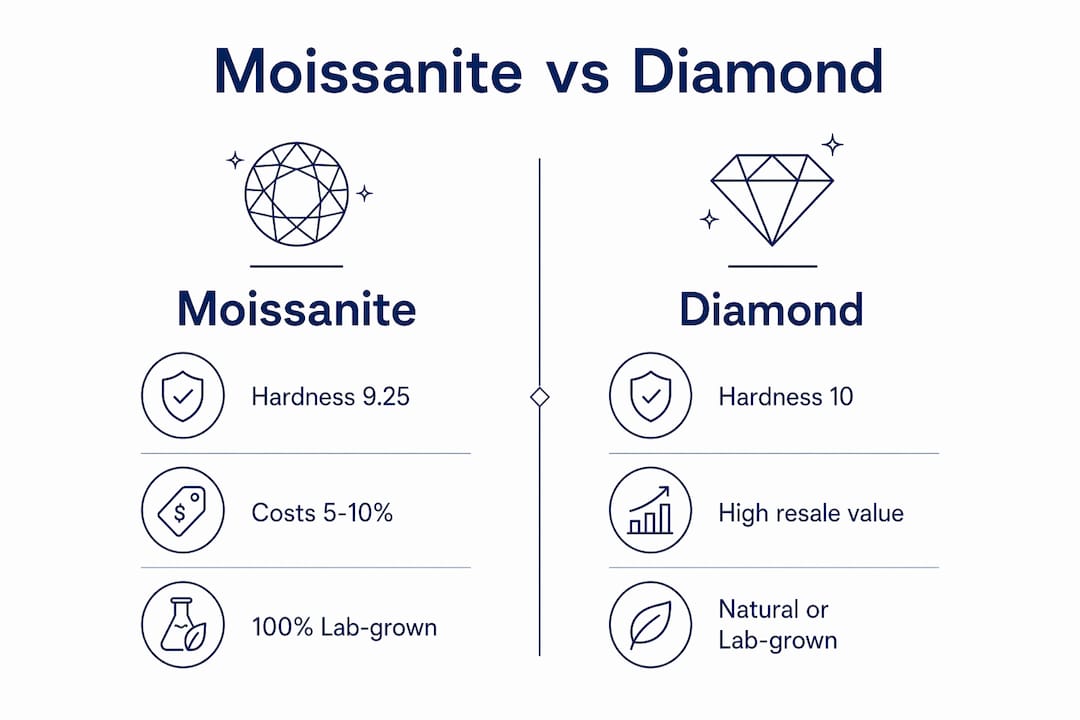
When people debate durability, they almost always reach for the Mohs scale. Diamond scores a perfect 10. Moissanite scores 9.25 on the Mohs scale, making it the second hardest gemstone commonly used in jewelry. For practical purposes, that 0.75 point difference is negligible. You will not scratch moissanite by wearing it daily, washing your hands, or reaching into a bag.
Here is where the real difference shows up:
- Hardness: Diamond is the hardest known natural mineral. Moissanite is hard enough to resist scratching from almost every material you will encounter in normal life.
- Brittleness: Moissanite can be slightly more susceptible to chipping from a direct, hard impact at the right angle. Diamond, while hard, can also chip under certain strike angles. Neither is truly “unbreakable.”
- Longevity: Moissanite maintains brilliance indefinitely with minimal maintenance, unlike cubic zirconia, which clouds and degrades over years of wear.
- Daily wear suitability: Both stones handle rings, earrings, and pendants well under normal conditions.
The difference between moissanite and cubic zirconia deserves a mention here. Cubic zirconia is softer (around Mohs 8 to 8.5), loses its polish quickly, and becomes dull with daily wear. Moissanite does not share that weakness.
Pro Tip: If your jewelry will take real-world abuse, such as regular gym use or hands-on work, a bezel or protective setting matters more than the 0.75 Mohs difference between moissanite and diamond.
How moissanite and diamond look in real light
This is where the two stones part ways most visibly, and it is the factor most buyers underestimate before purchasing.
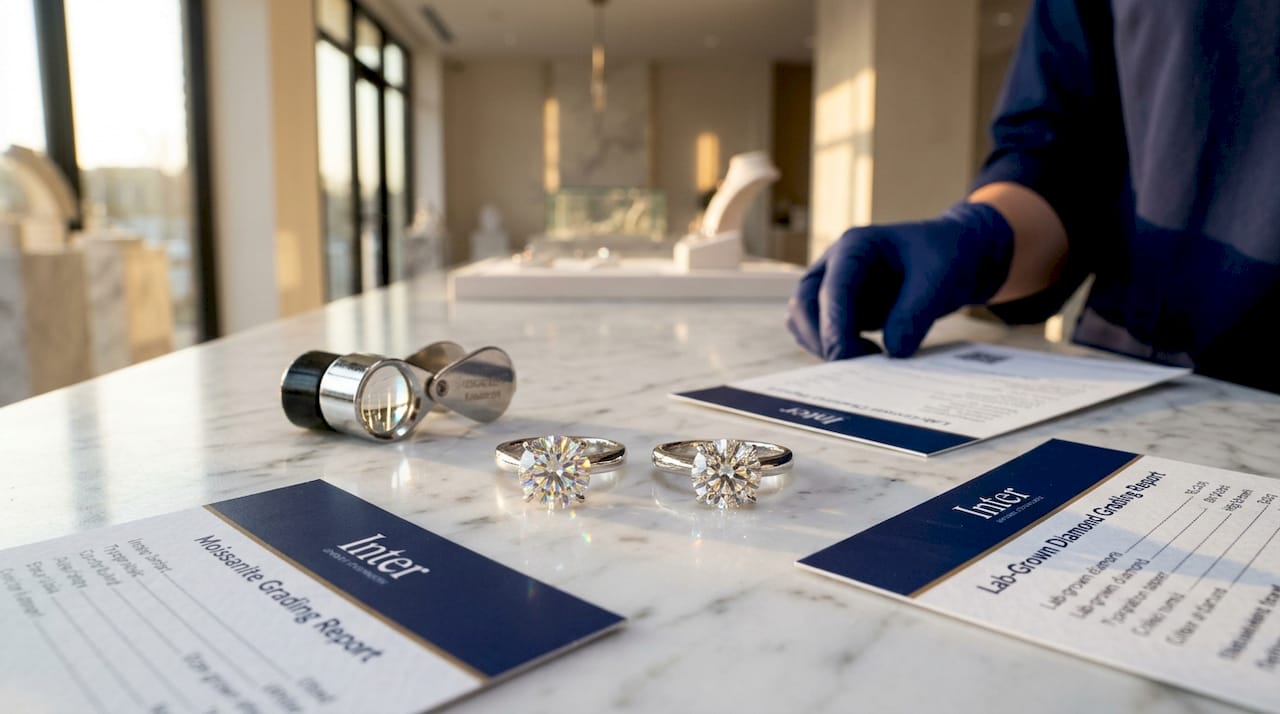
Moissanite has a higher refractive index of 2.65 to 2.69 compared to diamond’s 2.42. A higher refractive index means more light is bent inside the stone, which translates to more fire. Fire is the technical term for the colorful, rainbow-like flashes you see. Moissanite produces more of those vivid flashes. Diamond produces a crisper, brighter white sparkle that many describe as cleaner.
There is also a physical distinction called double refraction. Moissanite is doubly refractive, meaning light splits into two beams inside the stone. Under magnification or in bright sunlight, this creates what gemologists call the “disco ball effect,” where you see slightly doubled facet edges and more colorful dispersion. Diamond is singly refractive, producing a more uniform, classic sparkle pattern.
What this means practically:
- Indoors under warm light, moissanite and diamond look very similar to the untrained eye.
- In direct sunlight or bright environments, moissanite’s extra fire becomes obvious, producing vivid rainbow flashes.
- Larger moissanite stones show the double refraction effect more noticeably than smaller ones.
- Some buyers love the extra sparkle. Others find it too busy or “flashy” compared to the restrained elegance of a diamond.
Pro Tip: View stones side-by-side in both indoor and outdoor lighting before you buy. Your honest reaction to that comparison will tell you more than any spec sheet.
The key practical difference for most buyers, as gemologist comparisons confirm, is optical character under various lighting rather than durability numbers on a chart.
Price, resale value, and market realities
This is the section that changes the most minds. The moissanite vs diamond comparison in financial terms is stark, though it is getting more complicated as the market evolves.
| Gemstone | Approx. price per carat (2026) | Resale value | Certification |
|---|---|---|---|
| Natural diamond | $3,000 to $8,000+ | 20 to 60% of retail | GIA/IGI typically |
| Lab-grown diamond | ~$350 | Lower than natural, improving | IGI certified |
| Moissanite | ~$100 | Minimal to none | Charles & Colvard or equivalent |
Moissanite costs roughly 5 to 10% of natural diamond price for a comparable size and visual quality. That price gap has historically been the strongest argument for choosing moissanite. For the same budget, you can get a noticeably larger stone with more visible sparkle.
The resale story is less flattering. Natural diamonds retain 20 to 60% of original retail value, depending on certification, size, and quality. Moissanite has virtually no secondary market. You will not recoup your investment if you decide to sell or trade it later.
Lab-grown diamonds occupy a middle ground worth understanding. Lab-grown diamond prices have compressed to around $350 per carat as of 2026, compared to moissanite at roughly $100 per carat. The gap that once made moissanite the obvious budget choice has narrowed considerably. Lab-grown diamonds are chemically identical to natural diamonds, carry IGI certification, and offer an ethical sourcing story without the conflict-mining concern. Their resale value is lower than natural diamonds but trending upward as consumer acceptance grows.
If your goal is maximum visual impact per dollar, moissanite still wins. If you want a certified stone with diamond-level chemistry and better long-term flexibility, a lab-grown diamond is worth the modest premium.
Certification, ethics, and buying smart
Understanding what you are buying at the point of sale protects you from both overpaying and misunderstanding what you have.
Natural diamonds typically carry GIA or IGI certification documenting cut, clarity, color, and carat. Moissanite comes certified by Charles & Colvard or similar labs. Lab-grown diamonds come with IGI certification that mirrors the natural diamond grading process.
Here is where it gets tricky at the counter:
- Standard thermal diamond testers identify moissanite as diamond because both have similar thermal conductivity. A seller using only a thermal tester cannot confirm which stone you have.
- Accurate identification requires either advanced testers measuring electrical conductivity or a gemologist examining birefringence under magnification.
- Always request documentation. A certified stone with a grading report is verifiable; an uncertified stone is not.
- For moissanite, look for stones from established producers. For lab-grown diamonds, IGI certification is the industry standard.
Ethical sourcing is increasingly a deciding factor for buyers. Moissanite is 100% lab-grown, so it carries no conflict mining concerns. Natural diamonds have made progress with certification programs, but the supply chain is complex. Lab-grown diamonds offer diamond-level chemistry with full traceability.
Pro Tip: Ask the retailer directly: “Is this stone certified, and can I see the grading report?” Any reputable seller will answer yes without hesitation. If they hesitate, that is your answer.
How to decide which is right for you
Synthesizing a moissanite vs diamond comparison into a buying decision comes down to four personal factors. Work through them honestly.
- Budget. If you want a 2-carat stone but a 2-carat natural diamond is out of reach, moissanite gives you that size and sparkle at a fraction of the cost. Lab-grown diamonds now offer a credible middle option.
- Optical preference. Do you love vivid, colorful fire that catches the eye across a room? Moissanite delivers that. Do you prefer a classic, bright white sparkle that reads as restrained and elegant? Diamond is your answer. Neither is objectively better; they are different.
- Investment and symbolism. For buyers prioritizing investment and legacy, natural diamonds remain the stronger choice due to resale value and cultural weight. If the ring is about love and aesthetics, not financial preservation, that calculus shifts entirely.
- Ethical values. If conflict-free, traceable sourcing matters to you, both moissanite and lab-grown diamonds deliver that directly. Natural diamonds can too, but require more verification.
After working through those four factors, consider viewing stones side by side at a jeweler or requesting samples from an online retailer before committing. Cut quality matters enormously in both stones. A well-cut moissanite outperforms a poorly-cut natural diamond every time.
My perspective on choosing between these stones
I have seen buyers walk in certain they want a diamond and leave with a moissanite after holding both stones under sunlight. I have seen the opposite too. What I have learned is that the decision almost always comes down to two things most articles gloss over: lighting preference and emotional framing.
The “disco ball effect” is real, and in my experience, it is the single most divisive factor. Some people see moissanite’s vivid fire and fall in love with it. Others find it too busy for everyday wear. Neither reaction is wrong.
What I find frustrating is the retail pressure that still steers buyers toward natural diamonds by default. With lab-grown diamonds now at roughly $350 per carat, the financial case for moissanite is less clearcut than it was even two years ago. That is not a reason to dismiss moissanite, but it changes the conversation. The right question is no longer just “moissanite or diamond?” It is “moissanite, lab-grown diamond, or natural diamond?” and the answer depends on what you actually value.
View both stones in real light. Define what the piece means to you. Then pick the stone that matches both.
— ICEVAULT
Find your stone at Icevaultatl
If you are ready to move from research to browsing, Icevaultatl makes it straightforward. The collection covers both certified moissanite jewelry and lab diamond engagement rings with competitive pricing and full product specs. Every piece is ethically sourced, which means no conflict supply chain concerns regardless of which stone you choose.
Browse iced out moissanite earrings for a vivid, high-impact look, or explore lab diamond stud earrings if you want diamond-grade chemistry at a fraction of the price of natural stones. Detailed specs, carat weights, and customer photos are available on each product page so you can see exactly what you are getting before you buy. Icevaultatl specializes in exactly these stones, which means the guidance you get is specific, not generic.
FAQ
What is the main difference between moissanite and diamond?
Moissanite is silicon carbide with a higher refractive index than diamond, producing more colorful fire. Diamond is pure carbon, the hardest natural mineral, with a crisper white sparkle and stronger resale value.
Can jewelers tell moissanite apart from diamond?
Standard thermal testers cannot reliably distinguish the two because both conduct heat similarly. Accurate identification requires electrical conductivity testing or magnification to observe moissanite’s double refraction.
Is moissanite a good diamond alternative for an engagement ring?
Yes. Moissanite rates 9.25 on the Mohs scale, resists scratching effectively, and maintains its brilliance indefinitely. It costs significantly less than a natural diamond of the same size, making it a practical choice for buyers who prioritize aesthetics over resale value.
How does moissanite compare to cubic zirconia?
Moissanite is considerably harder than cubic zirconia, which rates around 8 to 8.5 on the Mohs scale. Cubic zirconia clouds and loses polish over time with daily wear. Moissanite does not degrade and retains its optical brilliance for decades.
Are lab-grown diamonds a better choice than moissanite?
It depends on your priorities. Lab-grown diamonds are chemically identical to natural diamonds, carry IGI certification, and now cost around $350 per carat versus roughly $100 per carat for moissanite. If certification, diamond chemistry, and improved resale flexibility matter to you, the premium is worth considering.