
Most people assume diamond color means how sparkly a stone looks. It does not. Diamond color refers to how much body tint a diamond carries, and it has a direct, measurable impact on both price and appearance. Understanding what is diamond color means knowing the difference between a stone graded D and one graded M, why a pink diamond costs more than a colorless one, and how your choice of metal setting quietly shifts everything you think you see. This guide breaks it all down without the confusing gemologist speak.
Table of Contents
- Key takeaways
- What is diamond color and what causes it
- The GIA D-Z color grading scale explained
- Fancy colored diamonds: types, grading, and rarity
- How to determine diamond color when buying
- Diamond color and the other quality factors
- My take on diamond color selection
- Lab-grown diamonds with certified color grades
- FAQ
Key takeaways
| Point | Details |
|---|---|
| Color grades D to Z | The GIA scale measures absence of color, with D being perfectly colorless and Z showing a visible yellow or brown tint. |
| Fancy colors are graded separately | Pink, blue, and green diamonds use a different grading system based on hue and intensity, not the D-Z scale. |
| Setting metal changes perception | Yellow gold can mask slight body tint in lower-grade diamonds, making a G or H look just as white as a D. |
| Lab-grown diamonds carry certified grades | Lab-created stones receive the same color grading certifications as mined diamonds, giving you verified quality. |
| Cut and fluorescence affect appearance | The same color grade can look different depending on how the diamond is cut and whether it fluoresces. |
What is diamond color and what causes it
Diamond color, in the industry’s technical sense, describes the degree to which a white diamond deviates from being completely colorless, or the presence and saturation of hue in a fancy colored stone. Two separate forces produce these results: trace chemical elements and structural defects in the crystal lattice.
Here is how those causes break down by color:
- Yellow: Nitrogen impurities absorbed during formation are the most common cause. Nitrogen replaces carbon atoms in the lattice and absorbs blue light, reflecting a yellow tone back to your eye.
- Blue: Boron impurities substitute for carbon atoms and absorb red and yellow light, producing the cool blue you see in stones like the Hope Diamond.
- Brown: Structural distortions in the crystal lattice create earthy, champagne, and cognac hues. No foreign element is required. The lattice itself is simply deformed.
- Pink and red: Plastic deformation during the stone’s journey from deep in the earth to the surface physically alters the crystal structure. This is why pink and red diamonds are extraordinarily rare.
- Green: Radiation exposure after formation displaces carbon atoms and creates green tones.
The distinction matters for buyers because it explains why fancy colored diamonds are graded on an entirely different scale from white ones. A yellowish tint in a white diamond is a defect you pay less for. A vivid yellow in a fancy colored diamond is a prized attribute you pay a premium for.
Pro Tip: If you are looking at a white diamond, ask for the grading certificate and look specifically at the color grade, not just the overall grade summary. The number tells you nothing without the letter.
The GIA D-Z color grading scale explained
The Gemological Institute of America (GIA) created the D-to-Z color grading system, and it has become the global standard. D represents perfectly colorless diamonds. Each letter after D indicates progressively more visible yellow or brown body tint, ending at Z with a clearly tinted stone visible to the naked eye.
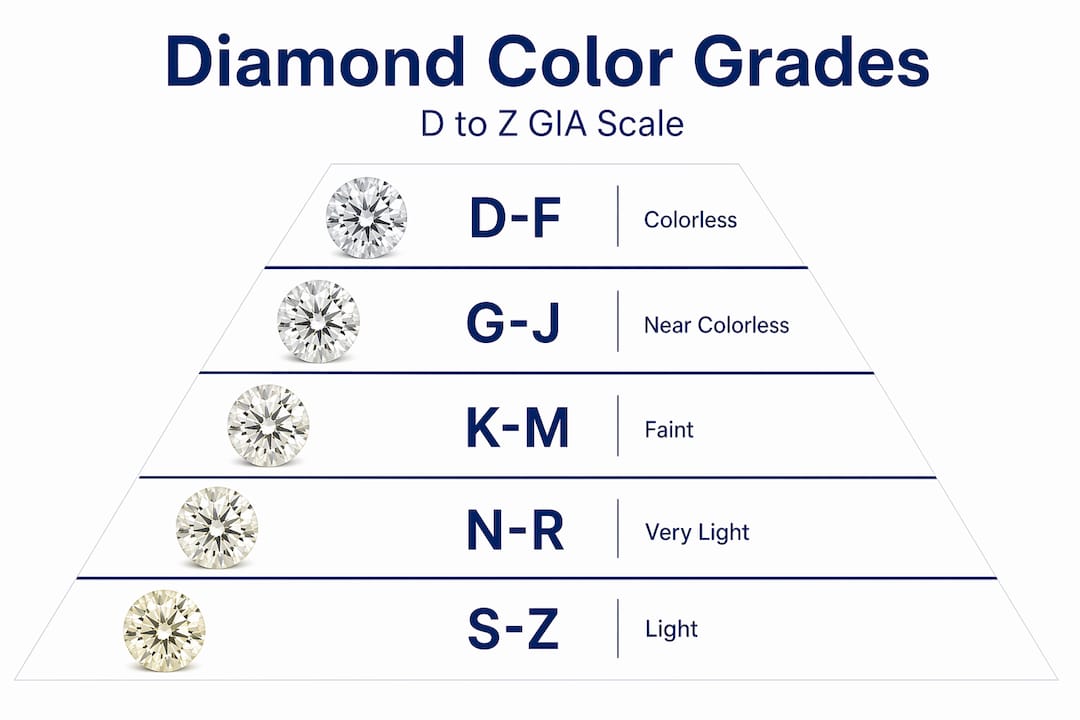
The scale is divided into five categories:
| Grade Range | Category | What you see |
|---|---|---|
| D, E, F | Colorless | No visible tint even under magnification |
| G, H, I, J | Near colorless | Slight tint visible face-down; appears white face-up |
| K, L, M | Faint | Faint yellow tint visible face-up in larger stones |
| N to R | Very light | Noticeable yellow or brown tint to most observers |
| S to Z | Light | Obvious tint visible without magnification |
D-color diamonds are the rarest and most expensive in this category. A one-carat D-color, flawless diamond can cost two to three times more than the same stone in an H color. Yet many buyers cannot tell the difference between a D and an F with the naked eye, especially once a diamond is set in a ring.
The near-colorless range (G through J) is widely considered the sweet spot for value. You get a stone that looks white to any observer at normal viewing distance, without paying the rarity premium attached to the colorless tier.
The same color grade can look noticeably different depending on how the diamond is cut. A well-cut G-color stone can appear brighter and whiter than a poorly cut E. This is why the color grade and the cut grade must always be evaluated together.
Fancy colored diamonds: types, grading, and rarity
Fancy colored diamonds operate in a completely separate world from the D-Z scale. Where white diamond grading rewards absence of color, fancy color grading rewards the presence, depth, and purity of a specific hue. The GIA grades fancy colored diamonds across nine intensity levels, from Faint to Fancy Vivid, with Fancy Vivid commanding the highest prices.
Common fancy colors and what makes each one notable:
- Yellow: The most commonly found fancy color, produced by nitrogen. Grades range from Fancy Light Yellow to Fancy Vivid Yellow. Fancy yellow diamonds are the most accessible entry point into colored stone collecting.
- Pink: Produced by plastic deformation. Extremely rare in nature. Pink diamonds from the now-closed Argyle mine in Australia are especially prized, and the Argyle grading system developed its own proprietary intensity scale reflecting how specialized the market became.
- Red: The rarest of all fancy colors. Fewer than 30 natural red diamonds are known to exist worldwide, making them effectively priceless at auction.
- Blue: Caused by boron. The closer to pure blue (without gray secondary tones), the higher the value.
- Green: Radiation-induced. Authenticity is difficult to verify since color can be artificially enhanced, making provenance critical.
- Brown: Structurally caused and more common than other fancy colors. Often sold under trade names like “champagne” or “cognac” to soften the commercial perception.
Fancy colored diamonds create a genuinely different buying proposition for consumers. If you want something that stands apart from a traditional white solitaire, a certified fancy colored stone offers rarity, visual impact, and a strong story. Lab-grown technology has also made some fancy colors more accessible without sacrificing certification standards.
How to determine diamond color when buying
Knowing the grading scale is one thing. Knowing how to actually assess diamond color during a purchase is another. These two skills do not automatically come together.
Follow this approach when evaluating color in person or online:
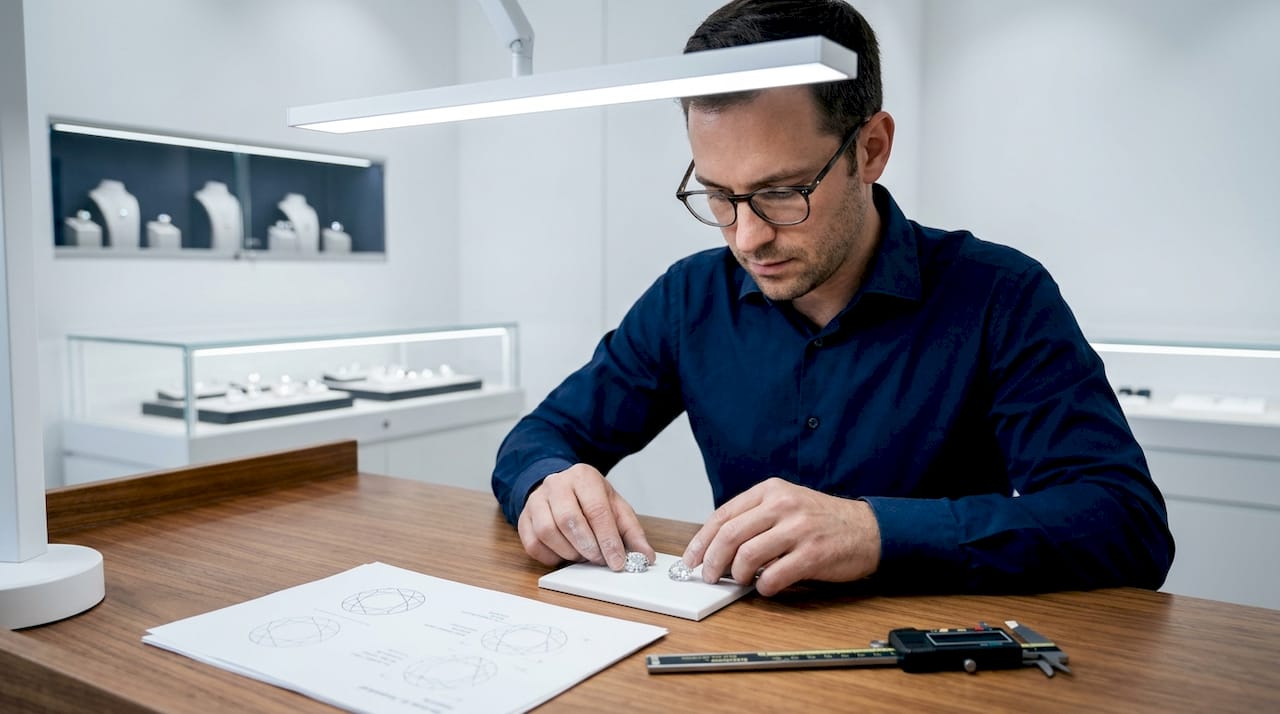
- View the diamond face-down. Color is most visible from the pavilion (bottom) of a diamond. Graders assess color with the stone inverted. If you are in a store, ask to see the stone table-down against a white background.
- Consider the setting metal. Body tint is more visible in larger stones, and a white metal like platinum or white gold amplifies any yellow tint. Yellow gold actually masks it. A G or H color diamond in a yellow gold setting will look just as white as a D in the same setting.
- Check for fluorescence. A diamond with strong blue fluorescence can appear whiter under UV-rich light (like sunlight) but may look milky indoors. This can work for or against you depending on the setting where the jewelry will most often be worn.
- Compare grades side by side. Color differences are subtle and invisible to untrained eyes without a reference point. If you are in a store, ask to see two grades next to each other. The gap becomes visible quickly.
- Match color grade to stone size. A faint tint in a 0.5-carat stone may be invisible. The same grade in a 2-carat stone shows up clearly. Scale your color expectations to the carat weight you are buying.
Pro Tip: For online purchases, always request the GIA or IGI grading certificate PDF, not just the summary card. Look at the actual color grade and the fluorescence description before making a decision.
Diamond color and the other quality factors
Color is one of the four Cs: cut, color, clarity, and carat weight. Each factor affects price and appearance, but they do not affect it equally in every situation.
Here is how color interacts with the others:
- Cut vs. color: Cut has the biggest impact on brilliance and light return. A well-cut diamond in an H color will outsparkle a poorly cut D every time. Prioritize cut first, then color.
- Clarity vs. color: Clarity measures internal inclusions. Most inclusions are invisible to the naked eye at VS2 and above. Color, by contrast, is often visible without magnification in grades below J. For most buyers, color affects appearance more directly than clarity.
- Carat vs. color: As carat weight increases, body tint becomes harder to hide. At one carat and above, staying in the near-colorless range (G through J) is a practical recommendation. Below 0.75 carats, you can often drop to K or L without visible penalty.
| Priority | Recommended approach |
|---|---|
| Maximum brilliance | Invest in Excellent cut, then G to H color |
| Budget value | Choose H to J color, VS2 clarity, Excellent cut |
| Large center stone | Stay at G or better to avoid visible tint |
| Yellow or rose gold setting | G to J color is sufficient; yellow masks tint effectively |
The honest truth is that color grade optimization depends entirely on what you are buying it for. A solitaire engagement ring under scrutiny needs different color consideration than a pave side stone or a pair of stud earrings.
My take on diamond color selection
I’ve watched buyers obsess over the difference between a D and an F, spending thousands more for a distinction that nobody in a social setting will ever notice. The gap in appearance between a D and a G is genuinely invisible to the naked eye once the stone is set. What you are paying for at the very top of the scale is rarity and certification prestige, not visible beauty.
What I’ve found actually matters is the combination of cut quality and setting choice. A G-color, Excellent-cut diamond in a white gold solitaire looks stunning. The same money spent chasing a D color with a Very Good cut is a worse outcome, visually and financially.
The insight most buyers miss: setting metal is a free color filter. Yellow and rose gold settings were not just a style trend. They were always a practical tool for getting more carat weight and better cut quality within a budget, by quietly masking any warmth in the stone’s body color.
My recommendation is always to lock in Excellent cut, stay in the G-to-J range for white settings, and use the saved budget to upgrade carat or clarity. You will get a better-looking ring, and you will not need a grading certificate to prove it.
— ICEVAULT
Lab-grown diamonds with certified color grades
At Icevaultatl, every lab-grown diamond comes with a verified color grade on its certificate, so you know exactly what you are buying before the order ships. The same GIA and IGI grading standards that apply to mined diamonds apply here. You can find D-color lab diamonds set in solid gold, along with near-colorless options that deliver excellent visual quality at a fraction of mined-diamond pricing.
For a practical entry point, the certified D-color stud earrings at Icevaultatl are a strong option for anyone who wants verified color quality in an everyday piece. Prefer E color at a lower price point? The E-color VVS2 studs offer the same certification rigor with a slightly more accessible budget. Browse the full collection of lab diamond rings and earrings to compare color grades, sizes, and settings side by side.
FAQ
What does diamond color actually measure?
Diamond color measures the degree of body tint in a white diamond, from perfectly colorless (D) to a visibly yellow or brown tinted stone (Z). It does not measure sparkle or clarity.
How do D and G color diamonds compare visually?
The visual difference between a D and a G color diamond is nearly undetectable to the naked eye once the stone is set. Both appear white in normal viewing conditions, though D is rarer and significantly more expensive.
What affects diamond color in a set ring?
Setting metal color, diamond size, and fluorescence all affect how body tint appears. Yellow gold masks warmth in lower-grade stones, while white gold and platinum make any tint more visible.
Are fancy colored diamonds graded the same way as white diamonds?
No. Fancy colored diamonds use a separate GIA intensity scale ranging from Faint to Fancy Vivid, graded by hue and saturation rather than absence of color. Lab-grown diamonds are available in both grading systems.
What is the best color grade for a budget buyer?
The G-to-J color range offers the best balance of visual whiteness and price. Most buyers cannot distinguish these grades from colorless diamonds once a stone is set, making them the practical choice for value-focused purchases.
Recommended
- 1ctw 14kt Solid Yellow gold vvs1 D Color Lab Diamond – ICEVAULT
- 1 CTW Lab Grown Diamond Stud Earrings – 5mm Round Brilliant | D Color – ICEVAULT
- Lab Diamond Engagement Rings (Custom & Classic Styles) | Icevault ATL – ICEVAULT
- .5 CTW Lab Grown Diamond Stud Earrings – 4mm Round | E Color VVS2 | 92 – ICEVAULT