
Diamonds are priced using a structured framework built on four measurable quality factors: carat weight, cut, color, and clarity. Known collectively as the 4Cs framework, this system was established by the Gemological Institute of America (GIA) and remains the global standard for how diamonds are valued. Beyond the 4Cs, trade benchmarks like the Rapaport Price List, retailer markups, and market supply and demand all shape the final cost of diamonds you see in stores or online. Understanding how these layers interact gives you real leverage before you spend a dollar.
How are diamonds priced using the 4Cs?
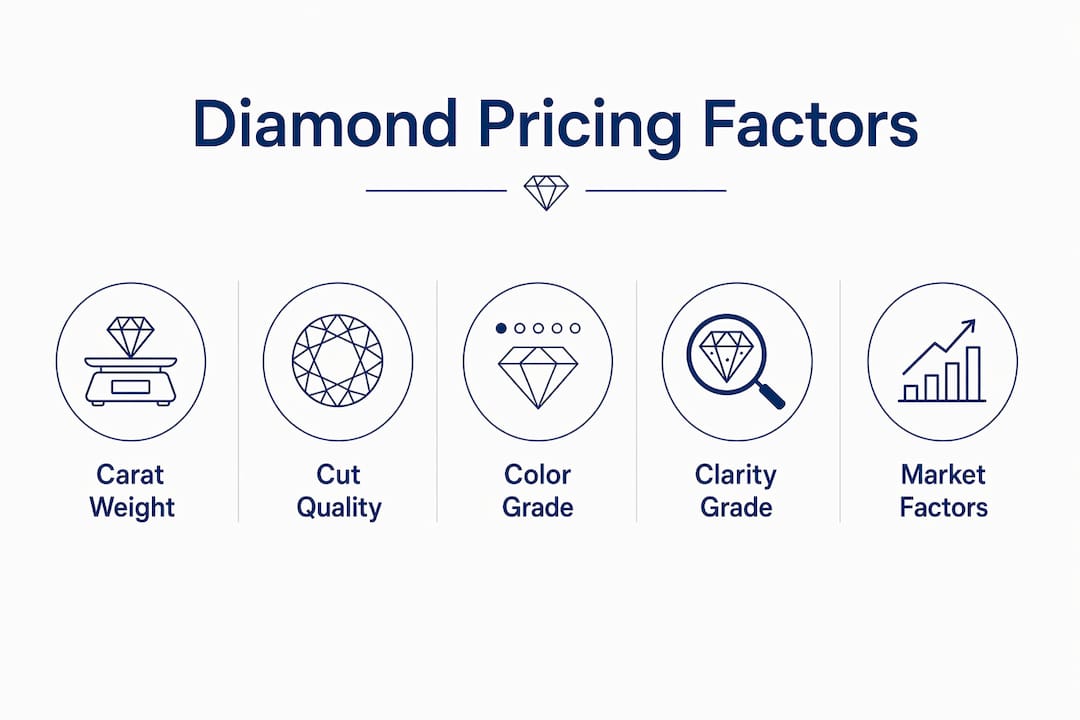
The 4Cs are the foundation of diamond pricing factors, and each one affects value in a distinct way. Cut determines brilliance, carat measures weight, color grades whiteness on a D-to-Z scale, and clarity grades internal flaws from Flawless (FL) to Included (I). No single C works in isolation. A 2-carat diamond with a poor cut and heavy yellow tint can cost less than a well-cut 1-carat stone in the near-colorless range.
Carat weight and the exponential price curve
Carat weight drives price more aggressively than any other factor. A 1-carat diamond costs roughly four times the per-carat price of a 0.5-carat stone, even though it is only twice the weight. This happens because larger gem-quality rough diamonds are exponentially rarer in nature. Price jumps are especially sharp at “magic sizes” like 0.50, 1.00, and 1.50 carats, where demand concentrates and sellers price accordingly.
Cut quality and why it is non-negotiable
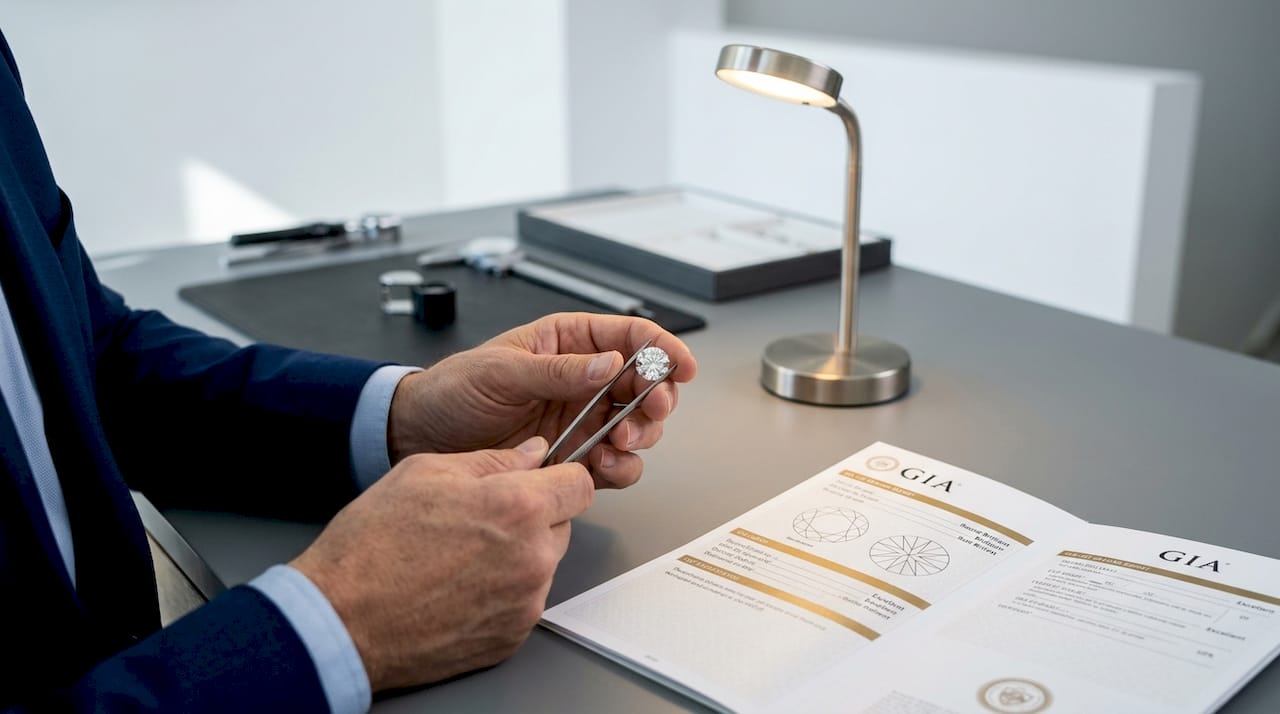
Cut is the only C that humans control entirely, and it is the single biggest driver of visual beauty. GIA grades cut on a scale from Excellent to Poor. An Excellent or Very Good cut maximizes light return, making a diamond appear larger and brighter than its carat weight suggests. Dropping to a Good or Fair cut to save money typically produces a stone that looks dull, which defeats the purpose of buying a diamond in the first place.
Color and clarity trade-offs
Color grades run from D (colorless) to Z (visibly yellow or brown). The practical sweet spot for most buyers sits between G and J, the near-colorless range, where the difference from a D-color stone is invisible to the naked eye but the price difference is significant. Clarity follows a similar logic. VS1 and SI1 grades are considered “eye-clean,” meaning no flaws are visible without magnification. Paying for FL or IF clarity rarely changes how the diamond looks in a ring.
Pro Tip: Choosing G color and VS2 clarity over D color and VVS1 clarity on a 1-carat stone can reduce cost by 30% or more with no perceptible difference in appearance.
The table below shows the relative price impact of each C at the 1-carat level:
| Factor | Grade range | Relative price impact |
|---|---|---|
| Carat weight | 0.5ct vs. 1.0ct | Highest. Price per carat roughly doubles or more. |
| Cut | Excellent vs. Good | High. Excellent cut commands a 15–25% premium. |
| Color | D vs. G | Moderate. D color adds 20–30% over G at same specs. |
| Clarity | VVS1 vs. VS2 | Lower. Eye-clean VS2 costs 15–20% less than VVS1. |
How do market factors and benchmarks shape diamond prices?
The 4Cs explain quality, but market forces explain price movement over time. Supply constraints, consumer demand, and macroeconomic conditions all push diamond prices up or down independent of any individual stone’s quality grade.
The Rapaport Price List is the wholesale benchmark the diamond trade uses globally. Updated weekly, it organizes prices by carat range, color, and clarity, giving dealers a starting point before applying markups. Consumers rarely see Rapaport prices directly, but understanding that they exist explains why two retailers can charge very different amounts for stones with identical GIA certificates.
Key market factors that affect diamond price include:
- Supply and rarity: Larger, high-quality rough diamonds are scarce, which drives exponential price increases at higher carat weights.
- Retailer overhead: Retail prices run 20% to 50% above wholesale or dealer cost, reflecting store overhead, staff, and brand positioning.
- Provenance and branding: Programs like the De Beers Origin initiative link diamonds to their source the way luxury watch brands use heritage, adding a price premium that has nothing to do with the 4Cs.
- Market cycles: The DIAMONDX market index shows natural diamond prices have fallen roughly 50% since 2022 to record lows, largely due to the rise of lab-grown diamonds compressing demand for mined stones.
The current price environment is actually favorable for buyers of natural diamonds. The combination of record-low mined diamond prices and competitive lab-grown options means consumers have more purchasing power right now than at any point in the past decade.
| Price driver | Direction of influence | Consumer implication |
|---|---|---|
| Rapaport benchmark | Sets wholesale floor | Negotiate closer to benchmark with certificate in hand |
| Retailer markup | Adds 20–50% above wholesale | Compare multiple sellers for identical cert specs |
| Branding and provenance | Adds premium above 4Cs value | Decide if origin story justifies the added cost |
| Market cycle (post-2022) | Downward pressure on mined prices | Buyers benefit from historically low natural diamond prices |
How do lab-grown diamonds compare to natural diamonds in price?
Lab-grown diamonds are chemically, physically, and optically identical to mined diamonds. The difference is origin and price. Lab-grown diamonds cost up to 40% less than mined diamonds, with lab-grown price per carat ranging from $500 to $1,000 compared to $800 to $2,000 for natural stones at comparable quality grades.
The price curve also behaves differently. Mined diamond prices rise exponentially with carat weight because of natural rarity. Lab-grown prices follow a more linear pattern because production costs scale more predictably. This means the savings advantage of lab-grown stones grows larger as carat weight increases.
Key reasons buyers choose lab-grown diamonds on price and value:
- Lower cost per carat: The same D-color, VVS1-clarity stone costs significantly less when lab-grown, freeing budget for a better cut or larger size.
- Identical grading standards: GIA and IGI both certify lab-grown diamonds using the same 4Cs criteria, so you get the same documentation and quality assurance.
- Ethical sourcing: No mining means no concerns about conflict sourcing or environmental disruption, which matters to a growing segment of buyers.
- Resale considerations: Lab-grown diamonds currently carry lower resale value than mined stones. If long-term resale matters to you, factor that into the decision.
Pro Tip: If you want maximum visual size and brilliance for your budget, a lab-grown Excellent-cut stone in the G-H color range gives you more carat weight than a comparable mined stone at the same price point.
How can you calculate and assess a fair diamond price?
Price per carat (PPC) is the most direct tool for comparing diamonds of different sizes. The formula is straightforward: divide the total price by the carat weight. A $4,500 stone at 1.5 carats has a PPC of $3,000. Comparing PPC across stones with similar GIA-certified grades tells you immediately which seller is pricing aggressively and which is not.
Here is a practical process for assessing fair value before you buy:
- Get the GIA or IGI certificate number. Every reputable diamond comes with a certificate. Use it to verify the exact grades independently on the GIA or IGI website.
- Calculate price per carat. Divide the asking price by the carat weight. Compare this figure across at least three sellers offering stones with the same color, clarity, and cut grade.
- Cross-reference against Rapaport. Trade professionals use the Rapaport benchmark to detect premiums or discounts. Retail prices above 50% of Rapaport suggest high overhead or brand premium.
- Target just under magic sizes. A 0.9-carat stone saves 10% to 15% compared to a 1.0-carat stone with no visible size difference in a setting. The same logic applies at 0.45ct vs. 0.5ct and 1.45ct vs. 1.5ct.
- Flag suspiciously low prices. A stone priced 40% below comparable certified diamonds usually signals misrepresented grades, missing certification, or undisclosed treatments. Walk away.
Pro Tip: Ask any seller for the stone’s Rapaport discount or premium percentage. A legitimate dealer will know this number. If they cannot or will not answer, that tells you something important about their pricing transparency.
The price per carat calculation works equally well for natural and lab-grown diamonds. Icevaultatl lists full specifications including carat weight, color, and clarity on every product, making the PPC comparison straightforward without needing to request additional documentation.
Key takeaways
Diamond pricing is determined by the 4Cs, amplified by carat weight’s exponential curve, and adjusted by market benchmarks, retailer markups, and origin factors that operate entirely outside the stone’s physical quality.
| Point | Details |
|---|---|
| 4Cs drive base value | Cut, color, clarity, and carat each affect price distinctly, with cut quality non-negotiable for visual appeal. |
| Carat weight scales exponentially | A 1-carat diamond costs roughly four times the per-carat price of a 0.5-carat stone due to rarity. |
| Rapaport sets the wholesale floor | Retail prices run 20% to 50% above this benchmark; comparing sellers against it reveals fair pricing. |
| Lab-grown diamonds cost up to 40% less | Identical grading standards apply, making lab-grown a strong value option for buyers prioritizing size and quality. |
| Magic size strategy saves real money | Buying just under 0.5, 1.0, or 1.5 carats cuts cost 10% to 15% with no visible size difference. |
The pricing game rewards informed buyers
The diamond market is not designed to be transparent. Rapaport prices are trade-only. Retailer markups are never disclosed on a price tag. And the 4Cs, while standardized, still leave room for two stones with identical grades to look dramatically different in person because cut quality has more nuance than a single grade captures.
What I have found working with lab-grown diamonds is that most buyers overpay in two predictable ways. First, they pay for color and clarity grades that exceed what the eye can detect, chasing D-FL specs that add cost without adding beauty. Second, they buy at magic sizes without realizing a 0.9-carat stone in a four-prong solitaire setting is visually indistinguishable from a 1.0-carat stone to anyone not holding a loupe.
The market shift since 2022 has been significant. Record-low natural diamond prices and the expansion of certified lab-grown options have genuinely shifted power toward buyers. The buyers who take advantage of this are the ones who show up with a GIA certificate number, a calculated PPC figure, and a willingness to compare three sellers before committing. The buyers who do not are the ones who pay a 40% retail premium for a stone they could have sourced for less.
My honest recommendation: prioritize cut above everything else, target G-H color and VS2-SI1 clarity for eye-clean results, and use the magic size strategy to free up budget for a better metal or setting. The diamond that looks best is rarely the one with the highest grade on paper.
— ICEVAULT
Explore lab-grown diamonds at Icevaultatl
Icevaultatl offers a full collection of certified lab-grown diamond jewelry priced with full specification transparency, so you can apply everything above before you buy. Every product listing includes carat weight, color grade, clarity grade, and cut details, making price per carat comparisons straightforward. The lab diamond engagement rings collection covers classic solitaires and custom styles, all using lab-grown stones graded to GIA and IGI standards. For buyers who want premium D-color, VVS1 clarity at a fraction of mined diamond pricing, the 1 CTW D Color lab studs show exactly what certified lab-grown quality looks like at a competitive price point. Ethical sourcing, full certification, and transparent pricing in one place.
FAQ
What are the main factors that affect diamond price?
The four main factors are carat weight, cut, color, and clarity, collectively called the 4Cs. Beyond these, retailer markups, market conditions, and provenance branding also influence the final price consumers pay.
Why do diamond prices jump at 1 carat?
One carat is a “magic size” where buyer demand concentrates, pushing the price per carat sharply higher. A 1-carat diamond can cost roughly four times the per-carat price of a 0.5-carat stone despite being only twice the weight.
Are lab-grown diamonds cheaper than natural diamonds?
Lab-grown diamonds cost up to 40% less than mined diamonds of comparable quality. The price per carat for lab-grown stones ranges from $500 to $1,000, compared to $800 to $2,000 for natural diamonds at similar grades.
How do I know if a diamond is fairly priced?
Calculate the price per carat by dividing the total price by the carat weight, then compare that figure across multiple sellers offering stones with identical GIA or IGI certified grades. Retail prices more than 50% above the Rapaport wholesale benchmark typically reflect high overhead or brand premium.
Does diamond color grade matter as much as cut?
Cut matters more than color for visual appearance. Near-colorless grades G through J are indistinguishable from D-color to the naked eye in most settings, while a poor cut visibly dulls a diamond regardless of its color or clarity grade.