
Brilliance in diamonds is defined as the total amount of white light a diamond returns to your eye after light enters and reflects off its internal facets. This single property separates a stone that looks alive from one that looks dull, and it is primarily determined by cut, not by carat weight or color grade. Understanding diamond brilliance explained in precise terms means recognizing that it is a physics outcome, not a marketing term. The GIA and IGI both treat brilliance as a measurable, engineered result of how well a diamond’s proportions manage light. If you are evaluating any diamond, whether lab-grown or mined, brilliance is the first number that should matter to you.
What is brilliance in diamonds and why does it matter?
Brilliance is the white light reflected back to the viewer from a diamond’s crown facets after light travels through the stone and bounces off the pavilion. Gemologists separate it from two related but distinct phenomena: fire and scintillation. Fire is the dispersion of light into spectral colors, the rainbow flashes you see when a diamond tilts. Scintillation is the pattern of light and dark contrast that shifts as the stone or the viewer moves.
These three properties together create what most people call “sparkle,” but they are not interchangeable. Brilliance, fire, and scintillation are separate light phenomena, each driven by different facet interactions. Brilliance is the dominant visual impression under most lighting conditions, which is why it is considered the foundation of a diamond’s visual appeal.
The importance of brilliance in diamonds goes beyond aesthetics. A stone with strong brilliance looks larger than its actual carat weight because brightness fills the visual field. A poorly cut diamond of the same carat weight can look smaller and flat. Cut quality is the one factor that directly controls this outcome.
How diamond cut determines brilliance
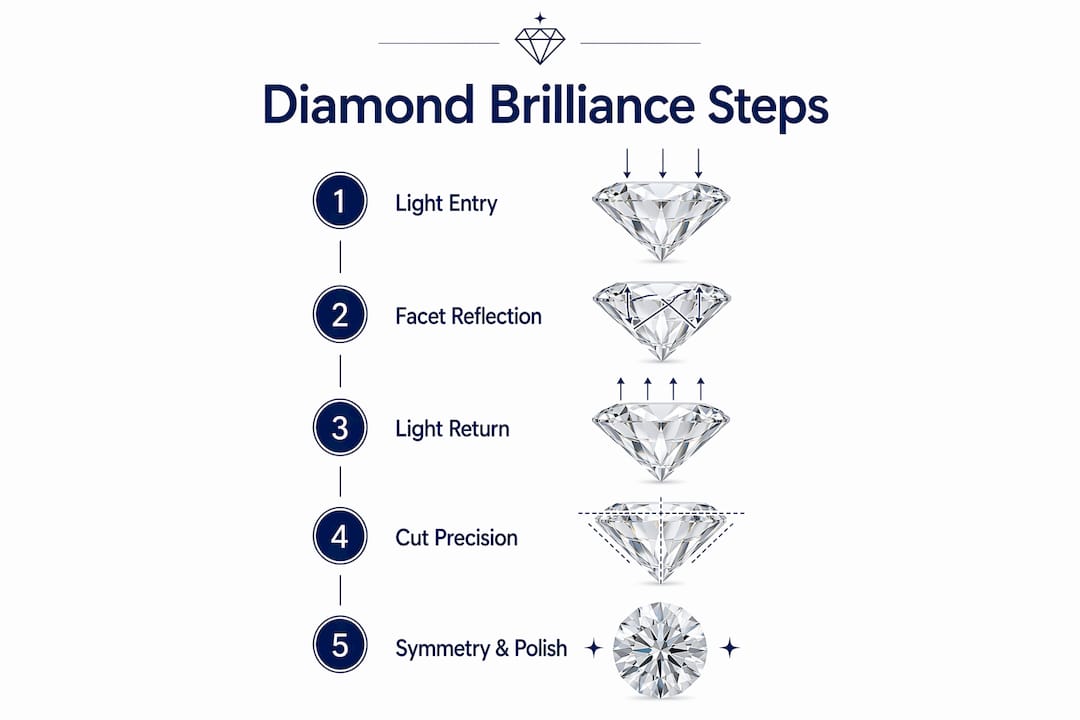
Cut is the primary factor that determines brilliance because it controls how effectively light is returned versus leaked out. The GIA cut grading system evaluates proportions, polish, and symmetry together, and an Excellent cut round brilliant efficiently returns white light and creates crisp, uniform brightness across the face of the stone.
The mechanics work like this. Light enters through the table facet, strikes the pavilion facets at precise angles, and reflects back up through the crown. When the pavilion angle is too shallow or too steep, light escapes through the bottom or sides of the stone instead of returning to your eye. This is called windowing, and it produces a dull, glassy appearance even in a diamond with strong color and clarity grades.
Here is what the cut grade spectrum means for actual light return:
- Excellent / Ideal: Maximum light return, crisp brightness, strong contrast pattern
- Very Good: Slightly less precise, but still high brilliance with minor trade-offs
- Good: Noticeable reduction in brightness, some light leakage visible face-up
- Fair / Poor: Significant windowing, flat appearance, brilliance is visibly compromised
Facet arrangement, symmetry, and polish all impact brilliance by determining light paths and reflection sharpness. Even minor deviations from ideal proportions can reduce sparkle in ways that are immediately visible to the naked eye. The round brilliant cut, with its 57 to 58 precisely arranged facets, was engineered specifically to maximize this light return through exact proportional relationships.
Pro Tip: When comparing two diamonds of the same carat weight and color, always prioritize the one with the higher cut grade. A G-color Excellent cut stone will outperform an E-color Good cut stone in every lighting condition.
Brilliance vs fire in diamonds: understanding all three optical properties
Brilliance vs fire in diamonds is a distinction that confuses most first-time buyers, and the confusion is understandable because all three optical properties appear simultaneously. Separating them requires knowing what each one looks like in isolation.
- Brilliance: White light return. The overall brightness you see when looking straight at the stone under ambient light.
- Fire: Colored light dispersion. The flashes of red, orange, blue, and violet that appear when the stone is tilted or when a point light source hits it at an angle.
- Scintillation: Dynamic sparkle. The shifting pattern of bright and dark areas that appears when either the stone or the viewer moves.
Human perception of sparkle depends on contrast and movement. Too much uniform brightness without contrast actually looks flat, which is why scintillation plays a supporting role in making brilliance appear more intense. A diamond that returns all white light with no dark contrast pattern can look like frosted glass rather than a brilliant stone.
Fire is most visible in low-light or single-source lighting, such as candlelight or a spotlight. Brilliance dominates in diffuse lighting, such as an overcast day or fluorescent office light. This is why a diamond that looks spectacular in a jewelry store’s spotlight may appear less dramatic in natural daylight, and vice versa. Understanding this balance helps you evaluate a stone across multiple lighting conditions before purchasing.
How is diamond brilliance measured?
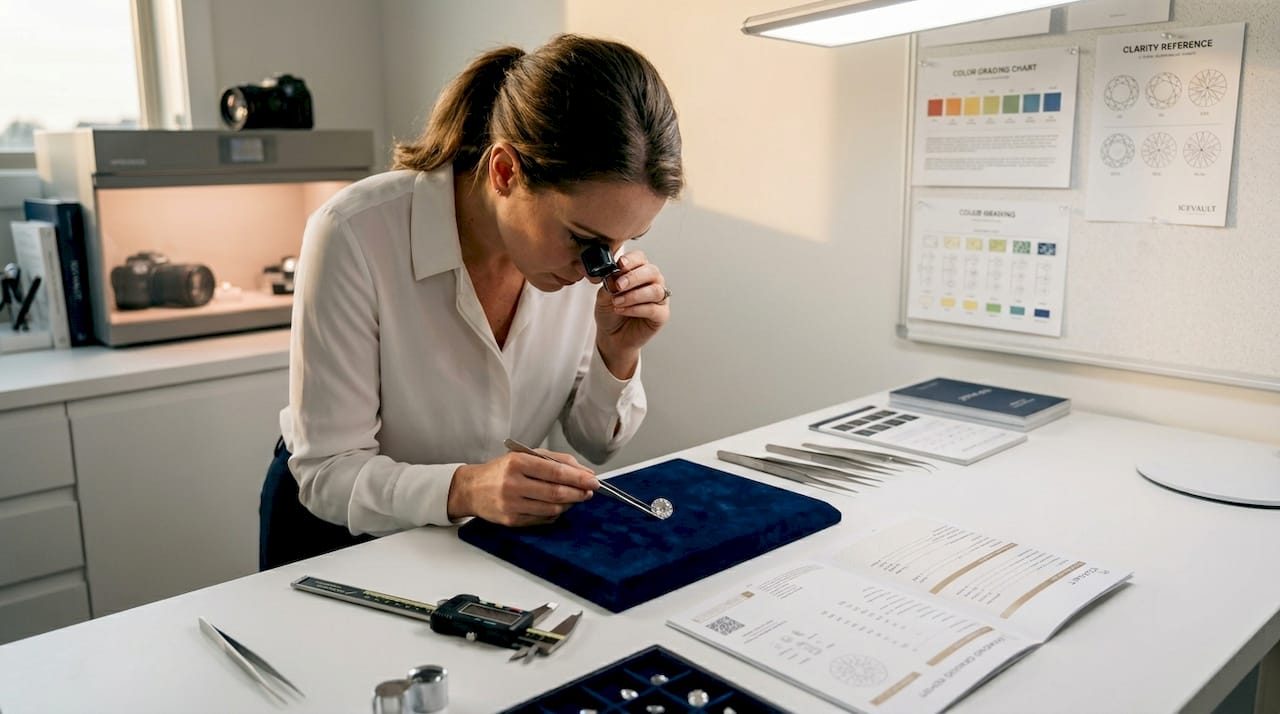
How diamond brilliance is measured has evolved significantly beyond simple cut grading. The IGI Light Performance Report provides subcomponent scores that quantify brightness, fire, and contrast from a standard viewing distance of 40 centimeters. This structured-light testing approach uses controlled environments to score light return and leakage objectively, which helps differentiate diamonds that share identical cut grades but perform differently in real viewing conditions.
The table below shows the key metrics used in light performance evaluation:
| Metric | What it measures | Why it matters |
|---|---|---|
| Brightness | Total white light returned face-up | Core measure of brilliance |
| Fire score | Colored light dispersion intensity | Indicates spectral flash potential |
| Contrast pattern | Light-dark balance across the face | Affects perceived depth and sparkle |
| Light leakage | Light escaping through pavilion | Identifies windowing problems |
Scientific measurements of brilliance use structured light environments to objectively score light return and leakage. These tools reveal differences between diamonds that standard 4Cs grading cannot capture. Two diamonds with identical GIA Excellent grades can still perform differently under real-world lighting, and a light performance report quantifies that gap.
One important limitation: GIA cut grading applies primarily to round brilliant diamonds. For fancy shapes such as ovals, cushions, or pear cuts, no universal cut grade exists. This means light performance grading systems become even more valuable when evaluating non-round stones, since the standard 4Cs report alone cannot tell you how well the stone actually performs.
Pro Tip: Ask your retailer for a light performance report alongside the standard grading certificate, especially for fancy-shaped diamonds. The traditional 4Cs don’t capture the visual experience that light performance reports quantify.
How to choose brilliant diamonds: a practical buyer’s guide
Choosing a diamond with strong brilliance requires a specific evaluation sequence. Most buyers focus on carat weight first, but cut dominates brilliance because it determines how light enters, reflects, and exits the stone. Color and carat cannot compensate for poor cut proportions.
Follow this sequence when evaluating any diamond:
- Start with cut grade. For round brilliants, select Excellent or Ideal only. For fancy shapes, request a light performance report or ask specifically about pavilion angle and table percentage.
- Inspect face-up in multiple lighting conditions. View the stone under diffuse daylight, fluorescent light, and a single spotlight. Brilliance should be strong in all three. A stone that only sparkles under a spotlight is relying on fire, not brilliance.
- Check for windowing. Hold the stone face-up over a white background and look for a transparent window in the center. A window means light is escaping through the pavilion instead of reflecting back to you.
- Compare side by side. Place two stones of similar specifications next to each other. The brighter stone is the better cut, regardless of what the certificate says about color or clarity.
- Verify certification. Diamonds graded by GIA or IGI carry credible, standardized cut assessments. Uncertified stones or stones graded by lesser-known labs carry real uncertainty about their actual cut quality.
A common mistake is trading cut quality for size. A 1.2-carat diamond with a Good cut grade will look smaller and duller than a 1.0-carat diamond with an Excellent cut grade. The size difference is barely visible; the brilliance difference is immediately obvious. Learning how to shop for lab diamonds with this framework protects you from the most common and costly purchasing error in the diamond market.
Pro Tip: Never evaluate a diamond under jewelry store lighting alone. Ask to take the stone near a window or under natural light. Store lighting is engineered to maximize fire and scintillation, which can mask a weak brilliance score.
Key takeaways
Brilliance is a cut-engineering outcome, and no amount of color grade or carat weight can restore it once the proportions are wrong.
| Point | Details |
|---|---|
| Brilliance defined | White light returned to the eye, controlled entirely by cut proportions and facet geometry. |
| Cut grade is primary | GIA Excellent cut round brilliants deliver maximum light return; Good or Fair grades produce visible dimness. |
| Brilliance vs fire | Brilliance is white light return; fire is colored dispersion; scintillation is dynamic contrast. All three are distinct. |
| Measure beyond 4Cs | IGI Light Performance Reports score brightness, fire, and contrast at 40 cm to reveal real-world sparkle differences. |
| Buy cut first | Prioritize cut grade over carat weight; a smaller Excellent cut stone outperforms a larger poorly cut stone every time. |
Why brilliance should be your first filter, not your last
At Icevaultatl, we see the same pattern repeatedly. A buyer comes in focused on carat weight, selects a 1.5-carat stone with a Very Good cut, and walks away satisfied. Six months later, they are back asking why their diamond looks dull next to a friend’s smaller stone. The answer is always cut.
Brilliance is what gives a diamond its sense of life. It is the property that makes a stone look like it is generating light rather than just reflecting it. A higher color grade moves a diamond from warm white to pure white, which is a subtle shift most people cannot detect without a comparison stone. A better cut grade moves a diamond from flat to luminous, which is a shift anyone can see from across a room.
The emotional connection people feel to a diamond is almost always a response to brilliance, not to the certificate. When someone says a stone “spoke to them” or “just looked different,” they are describing strong light return. That response is repeatable and predictable if you know what cut specifications to prioritize. We recommend viewing any diamond you are considering alongside a certified Excellent cut stone of similar size. The comparison does more to clarify your decision than any amount of specification reading.
— ICEVAULT
Find high-brilliance lab diamonds at Icevaultatl

Icevaultatl carries lab-grown diamonds cut to Excellent and Ideal specifications, with GIA and IGI certification available on every stone. Every product listing includes cut grade information so you can apply the brilliance framework from this article directly to your purchase decision. The 5mm round brilliant lab diamond studs are cut to D color Excellent grade standards, delivering maximum white light return in a classic setting. For those selecting an engagement ring, the lab diamond engagement ring collection features both custom and classic styles, all prioritizing cut quality as the primary selection criterion. Lab-grown diamonds offer the same optical properties as mined stones at a fraction of the price, which means you can afford to prioritize cut without compromising on size.
FAQ
What is brilliance in a diamond, exactly?
Brilliance is the total white light a diamond returns to your eye after light enters through the crown and reflects off the pavilion facets. It is distinct from fire (colored flashes) and scintillation (movement-based sparkle patterns).
What causes brilliance in diamonds?
Cut proportions cause brilliance. When pavilion angles, table size, and crown height are within precise ranges, light reflects internally and exits through the crown toward the viewer. Poor proportions cause light to leak out the sides or bottom, reducing brightness.
Does color or clarity affect diamond brilliance?
Color and clarity have minimal direct impact on brilliance. A lower color grade shifts the stone’s tint but does not reduce light return. Clarity affects brilliance only when inclusions are large enough to interrupt light paths, which is rare in stones graded SI1 or above.
How is diamond brilliance measured scientifically?
The IGI Light Performance Report measures brightness, fire, and contrast from a standardized 40-centimeter viewing distance using structured light environments. This produces objective scores that reveal sparkle differences between diamonds with identical cut grades.
Is a round brilliant cut the most brilliant diamond shape?
The round brilliant cut, with its 57 to 58 precisely engineered facets, consistently produces the highest brilliance scores of any diamond shape. Other cuts such as ovals and cushions can achieve strong brilliance, but they lack a universal cut grading standard, making evaluation more dependent on light performance reports and direct comparison.