
Moissanite is one of the most misunderstood stones in the jewelry world. Most people see it glittering in a ring and assume it’s a diamond, but moissanite is its own distinct gemstone with properties that actually surpass a diamond in several ways. If you’re shopping for an engagement ring, earrings, or any fine jewelry piece and want to understand your options before spending, this guide covers everything: what moissanite is made of, how it’s created, what makes it sparkle, how it compares to diamonds, and what to look for when buying.
Table of Contents
- Key Takeaways
- What is moissanite: origin, composition, and discovery
- Optical and physical properties of moissanite
- How moissanite compares to diamonds and other gemstones
- Benefits and considerations when choosing moissanite jewelry
- How to select and care for moissanite jewelry
- My take on why moissanite is worth your serious consideration
- Explore moissanite jewelry at Icevaultatl
- FAQ
Key Takeaways
| Point | Details |
|---|---|
| Moissanite’s origin | Discovered in a meteorite, moissanite is now lab-grown for all commercial jewelry use. |
| Optical brilliance | Moissanite has a higher refractive index than diamond, producing more fire and color flash. |
| Durability rating | At 9.25 on the Mohs scale, moissanite is one of the hardest gemstones available. |
| Ethical sourcing | All commercial moissanite is lab-created, making it a conflict-free and sustainable choice. |
| Cost advantage | Moissanite delivers diamond-level visual appeal at a fraction of the price. |
What is moissanite: origin, composition, and discovery
Moissanite is a gemstone made of silicon carbide, a compound of silicon and carbon. Its chemical structure gives it extraordinary hardness, heat resistance, and optical brilliance. Those properties are not accidental. They come from the same conditions that forged the stone in the first place.
The origin of moissanite stones traces back to outer space. In 1893, French chemist Henri Moissan discovered microscopic silicon carbide crystals inside a meteorite crater in Canyon Diablo, Arizona. He initially believed he had found diamonds. Closer analysis proved otherwise, and the mineral was later named moissanite in his honor. That cosmic beginning is part of what makes moissanite genuinely fascinating, not just a lab product designed to look like something else.
Natural moissanite is extraordinarily rare. Finding a gem-quality natural stone large enough for jewelry is nearly impossible, which is why all commercial moissanite sold today is created in a laboratory. Lab synthesis produces stones that are chemically and physically identical to natural moissanite, with the added benefit of controlled quality and no mining impact. The process involves growing silicon carbide crystals at very high temperatures in a controlled environment, then cutting and polishing the resulting material to jewelry standards.
Here’s what you should know about moissanite’s fundamental characteristics before looking at the optical details:
- Chemical composition: Silicon carbide (SiC)
- Natural source: Meteorites and extremely rare terrestrial deposits
- Commercial availability: Lab-grown only for practical purposes
- Color range: Colorless (D-E-F equivalent), near-colorless, and faint yellow or green options
Pro Tip: When buying moissanite, look for stones graded as “colorless” or “near-colorless.” These grades correspond roughly to the D-F and G-H diamond color scale, and they give you the cleanest, brightest appearance in white metal settings.
Optical and physical properties of moissanite
This is where moissanite genuinely stands out from every other gemstone on the market, including diamond. Understanding these properties helps you set accurate expectations and make a smarter purchase.
Brilliance and fire
What is moissanite brilliance, exactly? It comes from the stone’s refractive index of 2.65 to 2.69, compared to diamond’s 2.42. A higher refractive index means more light bends and reflects inside the stone before exiting, producing intense sparkle and what gemologists call “fire,” which is the rainbow-colored flashes you see when light hits the stone at different angles. Moissanite produces more fire than diamond. Whether you love that or find it slightly different from a diamond’s cooler, white-light sparkle comes down to personal preference.
Birefringence and how it’s managed
Moissanite is doubly refractive, meaning light splits into two beams as it passes through the stone. This is called birefringence, and it contributes to that distinctive rainbow flash. Unmanaged, it can create a slight doubling of facets when you look closely through the stone. Skilled cutters address this by orienting stones along the optic axis during cutting, which minimizes the visual doubling effect in the finished gem. Quality moissanite from a reputable source will have this accounted for.
Hardness and durability
On the Mohs hardness scale, moissanite scores 9.25, placing it just below diamond at 10 and above every other commonly used gemstone including sapphire (9), ruby (9), and emerald (7.5 to 8). For everyday jewelry wear, that hardness difference between 9.25 and 10 is functionally irrelevant. Your moissanite ring or earrings will resist scratching from virtually any surface you encounter daily.
The durability advantages extend further than scratch resistance:
- Heat resistance: Moissanite tolerates temperatures up to 1800°C without damage, which actually exceeds diamond’s tolerance. This matters during jewelry repairs involving heat, such as resizing or re-tipping prongs.
- Toughness: Moissanite resists chipping and cracking under normal wear conditions.
- Stability: It does not react to household chemicals, cleaning agents, or exposure to UV light in a way that degrades the stone.
These physical properties make moissanite a genuinely practical choice for rings and earrings worn daily, not just a visual substitute for diamond.
How moissanite compares to diamonds and other gemstones

Buyers considering moissanite most often compare it directly to diamond. The table below lays out the key differences clearly.
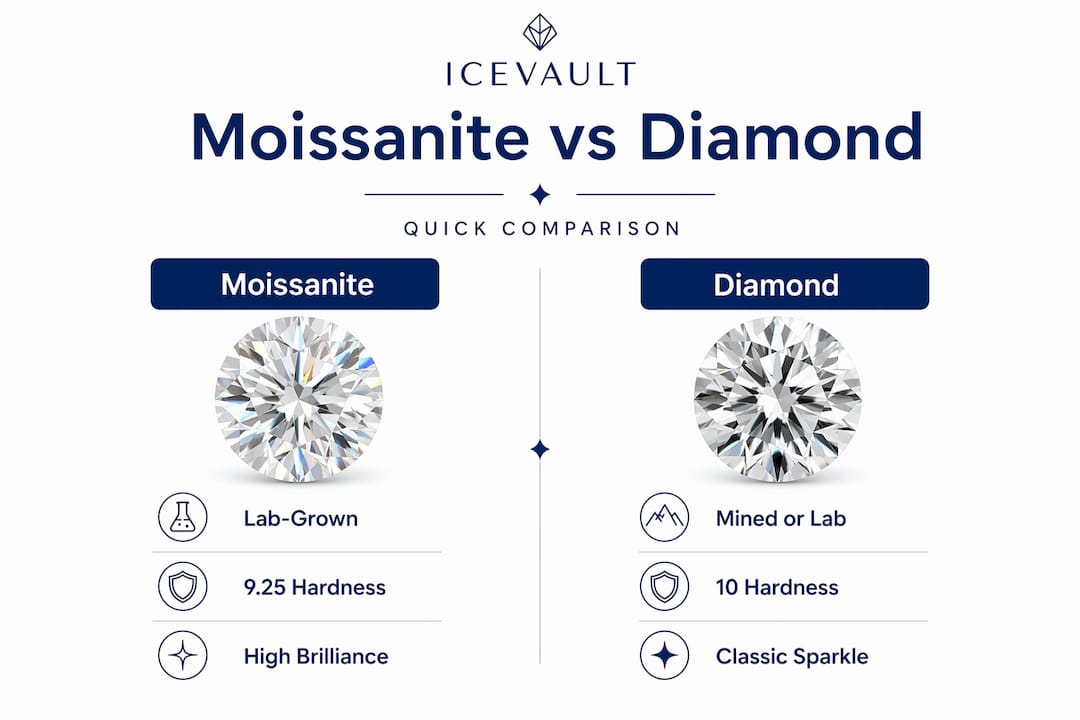
| Property | Moissanite | Diamond | Sapphire |
|---|---|---|---|
| Mohs hardness | 9.25 | 10 | 9 |
| Refractive index | 2.65 to 2.69 | 2.42 | 1.76 to 1.77 |
| Origin | Lab-grown | Mined or lab-grown | Mined or lab-grown |
| Price per carat (approx.) | $400 to $600 | $3,000 to $8,000+ | $500 to $2,000+ |
| Ethical sourcing | Conflict-free | Varies | Varies |
One issue that trips buyers up is testing. Many thermal conductivity testers cannot distinguish moissanite from diamond because both conduct heat similarly. Jewelers who rely on those older tools sometimes misidentify moissanite as diamond, or vice versa. The reliable ways to differentiate them are birefringence testing and UV fluorescence. Moissanite shows double refraction and slight fluorescence under UV light that diamond does not.
On the ethical side, lab-grown moissanite offers a clear advantage over mined diamonds. Every moissanite stone sold commercially today comes from a controlled lab setting, which means no mining, no displacement of communities, and no financing of conflict. For buyers who care about where their jewelry comes from, that matters.
Pro Tip: If a jeweler shows you a thermal tester result to “prove” a stone is diamond or moissanite, ask for a birefringence or optical test instead. Thermal testers alone are not conclusive for telling these two apart.
Benefits and considerations when choosing moissanite jewelry
The reasons to choose moissanite for jewelry go beyond price, though price is certainly part of the picture.
Affordability. A one-carat moissanite typically costs $400 to $600. A comparable one-carat diamond costs $3,000 to $8,000 or more depending on cut, clarity, and color. You are getting the same visual size and comparable brilliance for a fraction of the investment.
Ethical and environmental benefits. Because all commercial moissanite gems are lab-created, buyers don’t have to navigate the complex sourcing questions that come with mined diamonds. The lab-grown process has a significantly smaller environmental footprint.
Variety and customization. Moissanite is available in every major diamond cut: round brilliant, oval, cushion, princess, pear, and emerald, among others. That variety gives jewelry designers and buyers the same flexibility they’d have with diamond, at lower cost per stone.
Durability for daily wear. Given its hardness and heat resistance, moissanite handles the demands of daily wear better than many natural gemstones. The benefits of moissanite earrings and rings are especially clear for people who want jewelry that maintains its look without special handling.
One honest consideration. Moissanite’s double refraction creates more rainbow-colored flashes than a diamond. In bright light or sunlight, that effect is vivid and eye-catching. Some buyers love it. Others who specifically want the cooler, more subdued sparkle of a traditional diamond may find moissanite’s optical personality a little different. Neither is wrong. It’s simply worth knowing before you buy.
How to select and care for moissanite jewelry
Getting the most from a moissanite purchase comes down to a few specific decisions and consistent, simple maintenance.
- Buy from a reputable source. Look for sellers who specify the moissanite grade (colorless vs. near-colorless), provide a certificate of authenticity, and use quality metal settings such as 925 sterling silver, 14k gold, or platinum.
- Prioritize cut quality. A well-cut moissanite maximizes the stone’s optical properties. Round brilliant and cushion cuts tend to show moissanite’s fire most effectively. A poor cut will appear lifeless regardless of the stone’s inherent quality.
- Check the setting. Prong settings and bezel settings both work well for moissanite. Make sure the stone is secured properly and that the metal is hallmarked accurately.
- Clean regularly. Moissanite maintains shine without clouding over time with basic care. Clean with warm water, mild dish soap, and a soft brush every few weeks. Avoid ultrasonic cleaners if your stone is set in a prong setting with fragile metal work.
- Store separately. Although moissanite is hard enough to scratch other gemstones, it can also be scratched by diamond. Keep moissanite pieces in individual pouches or compartments.
Pro Tip: Avoid steam cleaners on moissanite earrings with glued components or pavé side stones. The heat can weaken adhesive settings. Stick to a soft brush and soapy water for safe, effective cleaning.
My take on why moissanite is worth your serious consideration
I’ve spent years working with buyers who come in expecting moissanite to be a compromise. They budget for something “almost as good” as diamond. Then they see it in person under the showroom lighting, and something shifts.
What surprises most people is that moissanite doesn’t look like a diamond trying to be better. It looks like itself. More fire, more rainbow flash, more personality. For buyers who value visual impact over resale value or tradition, that’s actually the better stone for them.
What I’ve learned is that the people who end up most satisfied with moissanite are those who chose it deliberately, not as a fallback. They understood the optical properties, made peace with the birefringence, and bought a quality cut in the right setting. They didn’t regret it later.
The one thing most buyers overlook is moissanite’s superior heat tolerance, which becomes relevant the first time a ring needs resizing. A jeweler working with moissanite doesn’t need to remove the stone during heat-based repairs the way they would with other gems. That’s a practical benefit that shows up years after the purchase.
If you’re choosing between diamonds and moissanite, the question isn’t which one is better. It’s which one fits your priorities. Moissanite is a popular diamond substitute precisely because for many buyers, it checks every box that matters: beauty, durability, ethics, and price.
— ICEVAULT
Explore moissanite jewelry at Icevaultatl
At Icevaultatl, you’ll find moissanite jewelry designed for people who want real quality without overpriced markups. The moissanite earring collection covers everything from classic studs to bold iced-out styles, all set in 925 sterling silver and crafted to show off moissanite’s exceptional brilliance. If you’re looking for a specific starting point, the 6mm halo moissanite studs are a popular choice for buyers who want maximum sparkle in an everyday earring. For buyers considering both moissanite and lab-grown diamonds, Icevaultatl also offers lab diamond stud earrings for a direct comparison in the same quality range. Every piece comes from an ethically sourced, lab-created gemstone with transparent pricing and no compromise on craftsmanship.
FAQ
What is moissanite made of?
Moissanite is made of silicon carbide, a compound of silicon and carbon. All commercially available moissanite for jewelry is lab-grown, as natural moissanite found in meteorites is too rare for practical use.
Is moissanite a real gemstone or a fake diamond?
Moissanite is a real, distinct gemstone with its own chemical composition and optical properties. It is not a fake diamond. It is a different stone that happens to look similar to diamond and shares several physical characteristics.
How hard is moissanite compared to diamond?
Moissanite scores 9.25 on the Mohs hardness scale, just below diamond at 10. That small difference has no practical impact on everyday wear. Moissanite is harder than sapphire, ruby, and all other commonly used gemstones.
Why are moissanite rings popular for engagement jewelry?
Moissanite rings are popular because they offer diamond-level visual appeal at significantly lower cost, come from conflict-free lab-grown sources, and are durable enough for daily wear. The stone’s high refractive index produces fire and brilliance that many buyers find more impressive than diamond.
Can a jeweler tell the difference between moissanite and diamond?
Standard thermal testers cannot reliably distinguish moissanite from diamond. A skilled gemologist can differentiate them using birefringence testing or UV fluorescence, since moissanite shows double refraction and slight green or yellow fluorescence that diamond does not.